

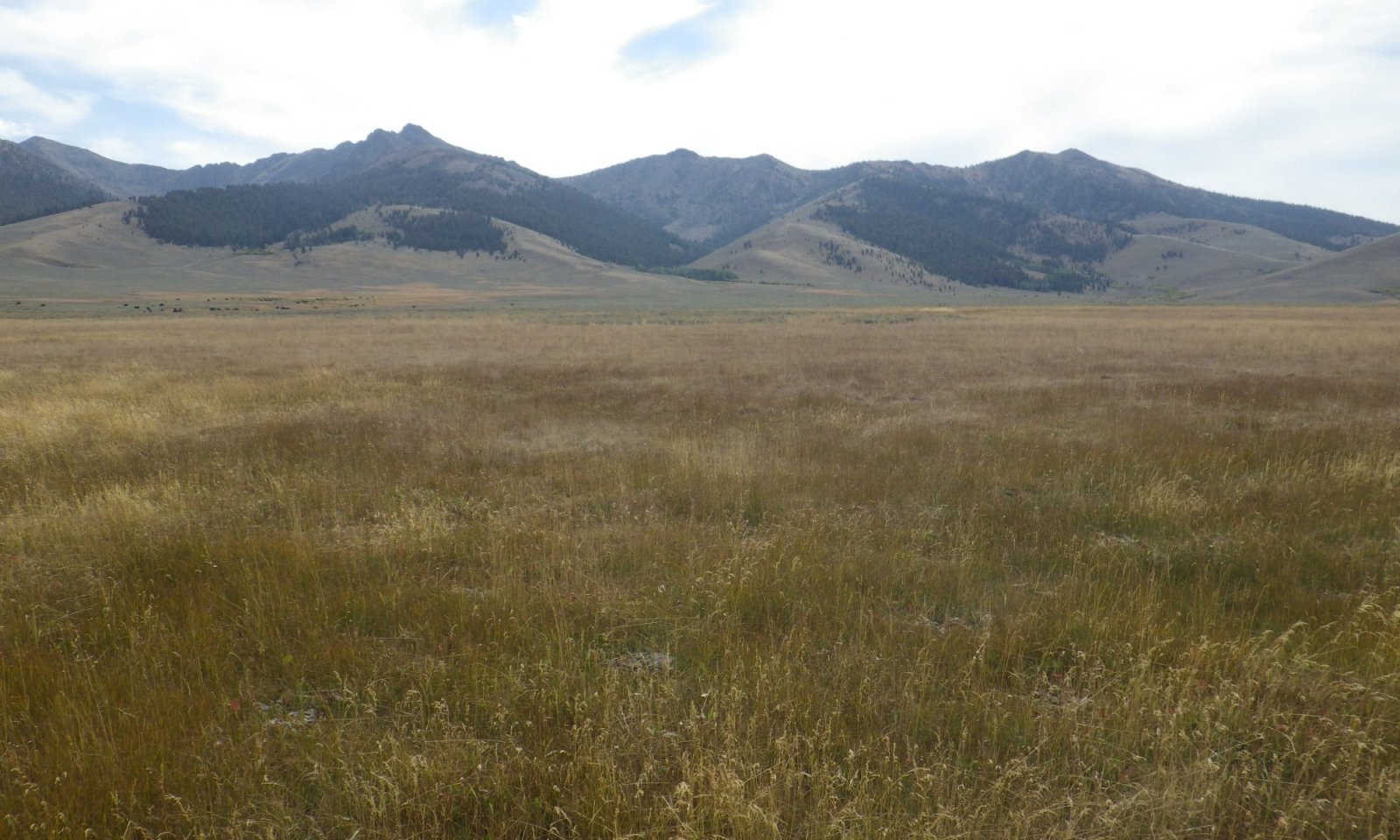
Wet Meadow Lost River Mountains

Scenario model
Current ecosystem state
Select a state
Management practices/drivers
Select a transition or restoration pathway
- Transition T1A More details
- Transition T1B More details
- Restoration pathway R2A More details
- Transition T2A More details
- Restoration pathway R3A More details
- Restoration pathway R3B More details
-
No transition or restoration pathway between the selected states has been described
Target ecosystem state
Select a state
Description
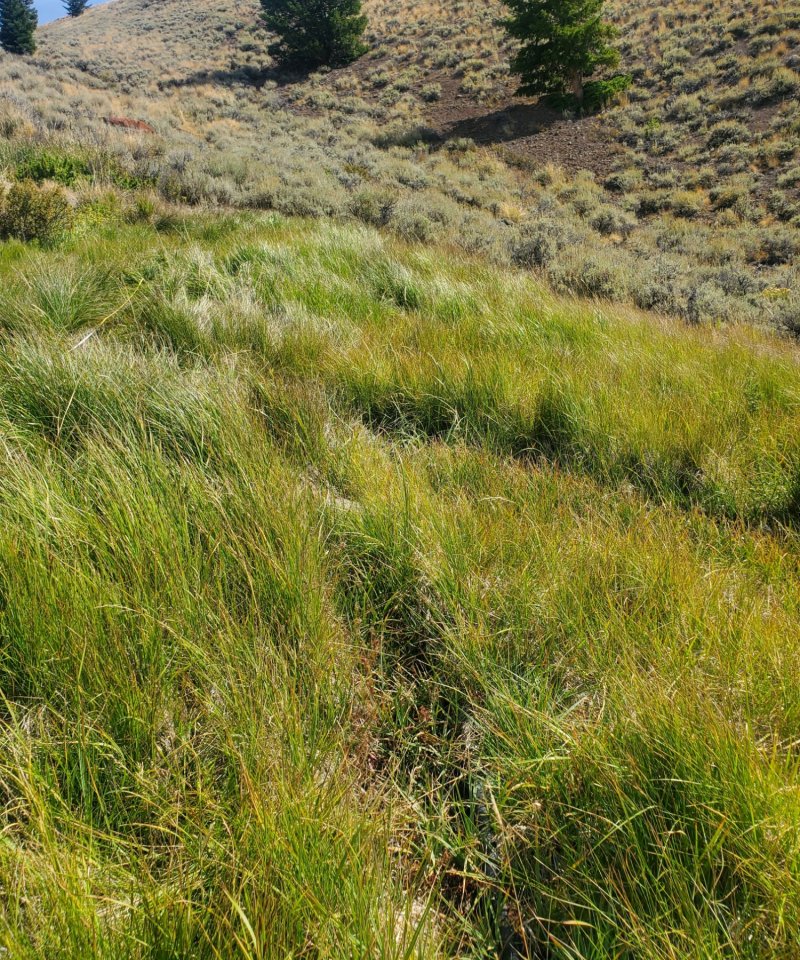
The Reference state consists of two dominant plant communities: A sedge and bunchgrass-dominated community and a shrub and sedge co-dominated community. The sedges and grasses in Community 1.1 can vary in composition and canopy cover but are highly productive and sedges tend to occupy a greater portion of the canopy than rhizomatous and bunchgrass species. In the shrub and sedge co-dominated community, willow (Salix) species are the primary shrub species but can include various species of currant, rose, cinquefoil, and others.
Processes (both natural and anthropogenic) that result in state and community changes include fire, grazing, land use change, and the occurrence of invasive species.
Characteristics and indicators
The Reference state is characterized by a plant composition of almost entirely native plants (less than five percent canopy cover of non-native species) that are highly productive with a dense canopy cover. Overstory vegetative cover ranges from 90 to 100 percent with less than three percent exposed bare ground. Production values in the Reference state range from 2,500 to 4,000 pounds per acre.
Resilience management
Resilience in the Reference state is high due to the aquic moisture regime and intact native plant communities. The additional water available via groundwater in a seasonal water table aids in resistance to drought as well as susceptibility to wildfire. The intact native plant communities provide a dense foliar cover with high amounts of surface litter and soil organic material that decreases susceptibility to erosion. Canopy cover of native vegetation decreases the ability for non-native, invasive species to establish.
Submodel
Description
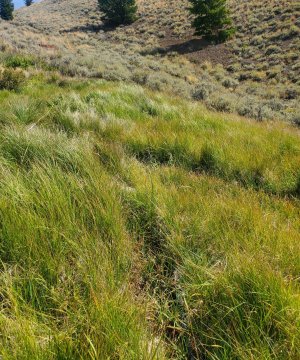
The Grazing Sustained state of the Wet Meadow ecological site occurs when agricultural grazing does not result in chronic defoliation or creation of pedestals, allowing for the recovery of most Reference state plants each growing season. In the Grazing Sustained state, annual production values decrease from that of the Reference state as a result of yearly defoliation. Canopy cover of native forb species increases as a result of canopy defoliation of more desirable grass and sedge species. Non-native species canopy cover will increase slightly, but remain under five percent in most circumstances. This state does not exhibit hummocks or pedestals due to high-intensity hoof traffic from grazing pressure.
Characteristics and indicators
The Grazing Sustained state of the Wet Meadow ecological site is similar to the Reference state in canopy cover and plant composition. The primary characteristic of this state is a reduction in total annual production and a slight shift in plant composition towards more grazing-tolerant grasses and a higher canopy cover of forbs. Invasive species canopy cover remains under five percent, though species like Kentucky bluegrass (Poa pratensis) and common dandelion (Taraxacum officinale) may exceed five percent canopy cover.
Resilience management
Resilience in the Grazing Sustained state is lower than the Reference state but remains moderate. In this state, hydrologic regimes remain intact and plant composition closely resembles that of the Reference state. Defoliation from chronic grazing results in canopy openings that increase the risk of invasive species recruitment as well as decrease resilience to drought. Soil organic matter and surface litter remain intact decreasing the risk of soil erosion.
Submodel
Description
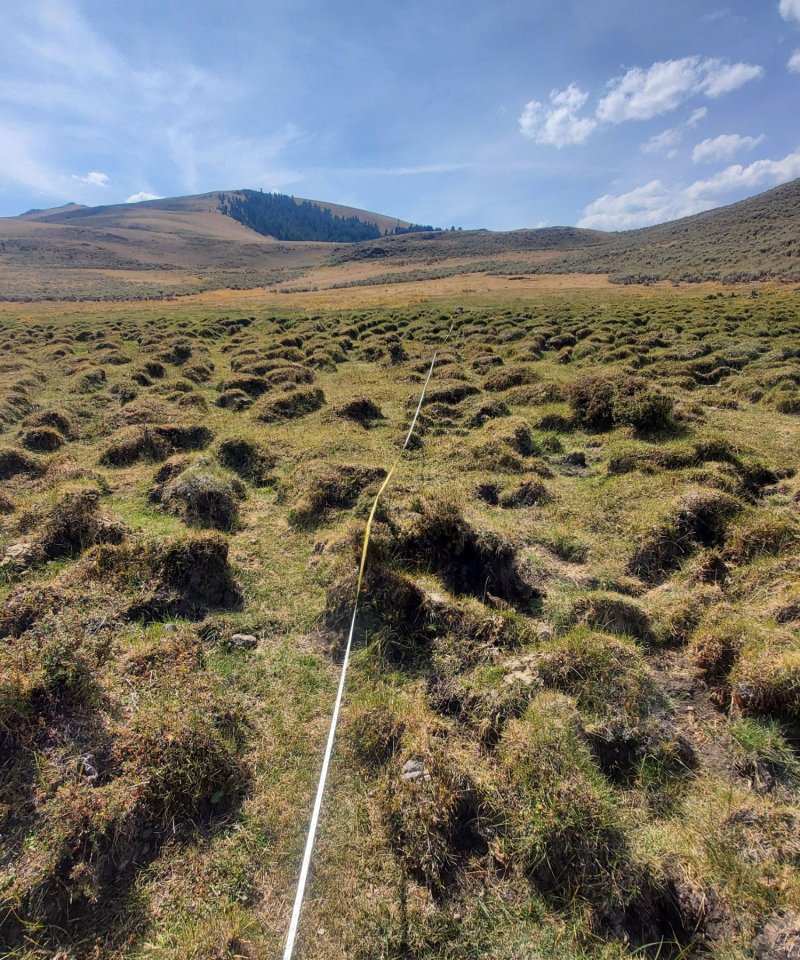
The Degraded state occurs when a disturbance disrupts the hydrologic regime for the site and a significant shift in plant composition and canopy cover occurs. The primary disturbance that causes a shift to the degraded state is high-intensity hoof traffic and chronic defoliation as a result of long-duration, intensive grazing practices. Other disturbances include mechanical land manipulation and severe erosion.
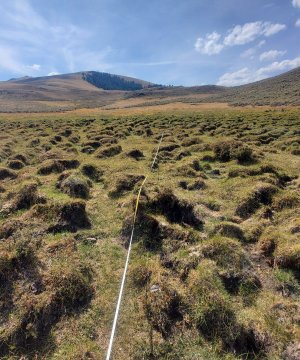
High-intensity hoof traffic from grazing animals during the wetter periods of the season can result in severe pedestaling. Severe pedestaling creates large fluctuations in depth to available groundwater, leaving the tops of pedestals occupied by upland plants that can tolerate less available moisture. Openings in the canopy previously occupied by sedges and grasses are replaced by disturbance-tolerant forbs and the amount of bare ground increases significantly.
Characteristics and indicators
The primary indicators of the degraded state include a shift in plant composition to drier, upland vegetation and the presence of severe pedestaling of soil. When pedestals form, depth to groundwater varies across the ecological site creating opportunities for vegetation requiring less moisture to establish.
A significant increase in forb canopy cover will occur as chronic defoliation of grass overstory creates openings in the canopy. Bare ground increases significantly in this state and non-native plant cover increases. Production is moderated as a result of hydrologic conditions and chronic defoliation, ranging from 750 to 1800 pounds per acre.
Resilience management
Resilience in the Degraded state is lower than in all other states because the site's hydrology has been modified and hydrologic regimes are no longer intact. Resistance to invasion from non-natives and annual grasses decreases with the loss of a properly functioning hydrologic system. Chronic defoliation and increased bare ground also decrease resistance to the invasion of non-native and undesirable species.
Submodel
Mechanism
The transition from the Reference state to the Grazing Sustained state is a mechanism of the introduction of low to moderate-intensity annual agricultural grazing. Grazing occurs at stocking rates and intensities that do not result in chronic defoliation and allow for the recovery of Reference state species each growing season. Hoof traffic occurs at a timing and intensity level that does not create pedestals or hummocks and does not interrupt site hydrology.
Constraints to recovery
Although this state is maintained by sustainable grazing, decreased grass canopy cover, increased forb canopy cover, decreased litter, and increased bare ground can be observed. This increases the opportunity for invasive or undesirable species to establish. Rest periods, decreases in stocking rates, or changes to grazing timing can aid in recovery back to the Reference state.
Mechanism
The transition from the Reference state to the Degraded state is a mechanism of high-intensity, long-duration grazing practices that result in chronic defoliation and the creation of pedestals and hummocks at the ecological site. Chronic defoliation of Reference state species drives a functional shift in plant species canopy, decreasing grasses and increasing forbs and bare ground. In addition, the recruitment and establishment of invasive and undesirable species is increased.
The creation of pedestals and hummocks interferes with the site's hydrologic regime, resulting in varying depths to seasonal water tables, increasing runoff, and facilitating land drainage (Booth et al. 2014). This drives a compositional shift to drier, upland species. Severe hummocks at a site can alter groundwater tables enough to transition the area to classify as a different ecological site.
Constraints to recovery
The primary constraints to recovery are continued intense grazing practices and lack of restoration of hydrologic function. If the depth to seasonal groundwater is deeper than 30cm and not mostly homogenous across the site, recovery toward the Reference state cannot happen.
Mechanism
The primary restoration strategy to transition back to the Reference state is rest from livestock grazing. Planting of desired species and noxious weed control may be required depending on the composition at a given site.
Context dependence
Restoration success is dependent on a functioning hydrologic system. Plants in the Reference state are groundwater-dependent and will not re-establish if seasonal groundwater tables fall deeper into the soil profile.
Mechanism
Transitions from the Grazing Sustained state to the Degraded state occur when the intensity and duration of grazing exceed the ability of the site to recover annually and hoof traffic, acutely or over time, creates surface hummocks or pedestals. Chronic defoliation of Grazing Sustained state vegetation results in diminished plant stature/vigor and canopy gaps. Forb canopy cover and opportunity for invasive or undesirable species recruitment increase.
Site hydrology is interrupted as hummocks form or become more pronounced. Hummocks increase runoff potential, facilitate land drainage, and create varying depths to seasonal water tables (Booth et al. 2014). This drives a shift in plant composition away from that of the Grazing Sustained state vegetation towards species more adapted to drier, upland conditions.
Constraints to recovery
The primary constraints to recovery are continued intense grazing practices and lack of restoration of hydrologic function. If the depth to seasonal groundwater is deeper than 30cm and not mostly homogenous across the site, recovery toward the Reference state cannot happen.
Mechanism
Restoration from the Degraded state to the Reference state requires restoration of hydrologic function and rest from agricultural grazing. Planting of Reference state species and weed control will likely be required for full restoration.
Context dependence
Restoration from the Degraded state is highly dependent on the ability to restore hydrology (severity of hummocks/pedestals) and plant composition. Time without grazing can repair hummocked areas when development is less severe through natural processes and sedimentation, however, mechanical techniques may be required if hummocks are severe.
Sites with a significant annual forb, invasive, or undesirable species composition may need mechanical treatment and post-treatment seeding for proper restoration to occur. Depending on the level of degradation, restoration from the Degraded state to the Reference state may be resource-intensive and require a significant period without further disturbance.
Mechanism
Restoration from the Degraded state to the Grazing Sustained state requires restoration of hydrologic function and rest from agricultural grazing. Planting of Reference state species and weed control may be required for full restoration.
Context dependence
Restoration from the Degraded state is highly dependent on the ability to restore hydrology (severity of hummocks/pedestals) and plant composition. Time without grazing can repair hummocked areas when development is less severe through natural processes and sedimentation, however, mechanical techniques may be required if hummocks are severe. Sites with a significant annual forb, invasive, or undesirable species composition may need mechanical treatment and post-treatment seeding for proper restoration to occur.
Model keys
Briefcase
Add ecological sites and Major Land Resource Areas to your briefcase by clicking on the briefcase ( ) icon wherever it occurs. Drag and drop items to reorder. Cookies are used to store briefcase items between browsing sessions. Because of this, the number of items that can be added to your briefcase is limited, and briefcase items added on one device and browser cannot be accessed from another device or browser. Users who do not wish to place cookies on their devices should not use the briefcase tool. Briefcase cookies serve no other purpose than described here and are deleted whenever browsing history is cleared.
Ecological sites
Major Land Resource Areas


The Ecosystem Dynamics Interpretive Tool is an information system framework developed by the USDA-ARS Jornada Experimental Range, USDA Natural Resources Conservation Service, and New Mexico State University.