Ecological dynamics
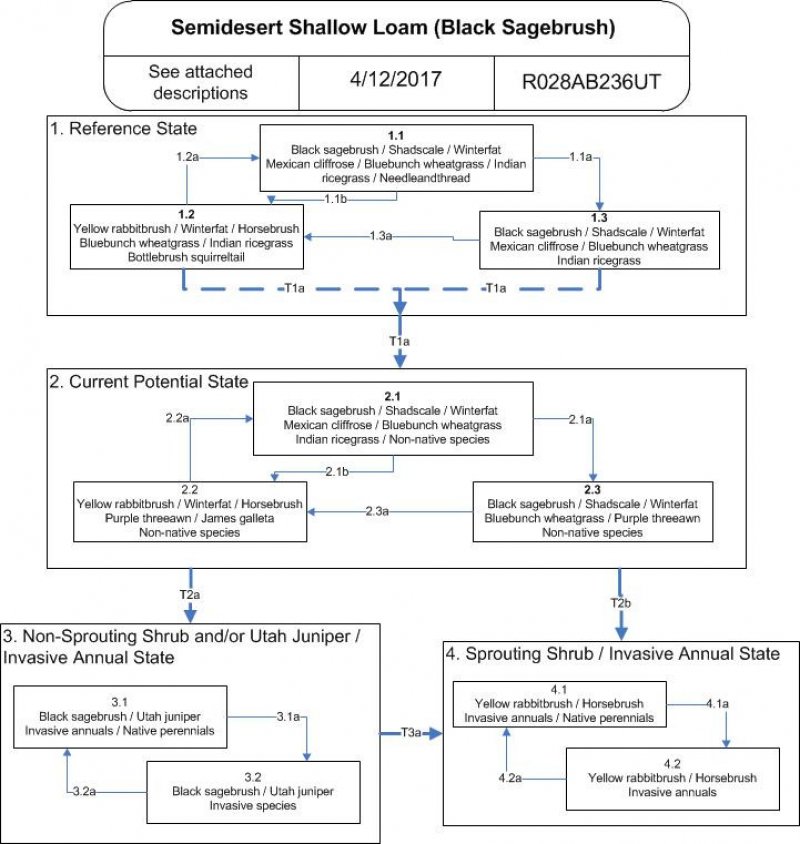
Black sagebrush is the dominant shrub in the ecological site with bluebunch wheatgrass as the dominant understory species. Fire in the Reference State can occur and increase the occurrence of fire tolerant shrubs, such as rabbitbrush (Chrysothamnus and Ericameria) and horsebrush (Tetradymia). Fire may also temporarily increase cover and production of grasses along with warm season grasses (see community phase 1.2). Shrubs can also increase in the absence of fire (see community phase 1.3). As ecological condition deteriorates due to overgrazing, lack of fire, and introduction of non-native species (see T1a), bluebunch wheatgrass and Indian ricegrass decrease, while black sagebrush, low rabbitbrush and snakeweed increase.
Cheatgrass (Bromus tectorum) and annual forbs are most likely to invade this site. Fire return intervals are often altered and decreased after the introduction of annual grasses and forbs. This can create an altered plant community and state (see T2b and State 4). Utah juniper can also increase in this site with the lack of fire (see T2a and State 3). There is no known recovery to State 1 or 2 from either of these alternate states.
State 1: Reference State
Narrative:
Community Phase 1.1: Reference State
This community is dominated by black sagebrush. Shadscale and Nevada ephedra are also commonly present. Winterfat and Mexican cliffrose are important browse species. Principle grasses include bluebunch wheatgrass, Indian ricegrass, needle and thread and bottlebrush squirreltail. Abundant forbs include carpet phlox and hairy balsamroot. Percent composition by air-dry weight is 45 percent grass, 5 percent forbs, and 50 percent shrubs. Natural fire frequency is estimated to be 50 to 60 years.
Reference State, Community 1.2: Black sagebrush decreases in the community. Shadscale, Mexican cliffrose and other shrubs may decrease also. Winterfat typically resprouts and recovers. Bluebunch wheatgrass, Indian ricegrass and other cool season bunchgrasses flourish. Yellow rabbitbrush and, at times, horsebrush (Tetradymia nuttallii) increase in the community. Much of the excess fine fuel accumulation is removed. Fire tolerant shrubs may persist as dominates for 30 years or longer.
Reference State, Community 1.3 – Black sagebrush increases significantly in percent composition. Shadscale, winterfat, Mexican cliffrose, and other shrubs typically increase also. Shrubs become decadent due to age. Bluebunch wheatgrass, Indian ricegrass, and other cool season bunchgrasses begin to lose vigor due to increased shrub competition and become dense with old vegetation. Percent composition by air-dry weight is 35 percent grass, 5 percent forbs, and 60 percent shrubs.
Community Pathways
1.1a – Extended period of time without a major disturbance such as fire, insect damage or drought. Fire frequency extends well beyond the 50 to 60 year average for the site.
1.1b – Recent fire occurrence, 1 to 30 years. Site is properly grazed.
1.2a – Normal fire frequency of 50 to 60 years returns on the site.
1.3a – Recent fire occurrence, 1 to 30 years. Site is properly grazed.
Transitions
T1a – Long-term improper grazing (including, season long overstocking, wrong season, etc.) and/or prolonged drought that removes fine fuels from the site lessening the potential for fire to occur. This allows both sprouting and non-sprouting shrubs such as black sagebrush, shadscale, winterfat, and yellow rabbitbrush to increase. Shrubs may become decadent due to age. Bluebunch wheatgrass, Indian ricegrass, and other perennial buchgrasses lose vigor and decrease in the community due to shrub competition and grazing pressures. Purple threeawn and sand dropseed may increase. Utah juniper seedlings and saplings may begin to invade the community if a seed source is present.
The threshold is crossed when there is an introduction of non-native species, primarily cheatgrass and various annual mustards, that become established in the community.
Prior to crossing the threshold, if the site is properly grazed over an extended period of time, native perennial vegetation may recover. Fire frequency can return to within normal range for the site. These events could set the site back into the normal range of variability.
State 2 – Current Potential State
Plant communities in this state can include native and acclimatized, naturalized and invasive non-native species. The Current Potential State is irreversibly changed from the Reference State because these non-native species will now remain a permanent part of the community.
Plant Community Narratives
Current Potential State, Community 2.1 - This community is dominated by black sagebrush. Shadescale and Nevada (jointfir) ephedra are also commonly present. Winterfat and Mexican cliffrose are important browse species. Principle grasses include bluebunch wheatgrass, Indian ricegrass, needle and thread, and bottlebrush squirreltail. Abundant forbs include carpet phlox and hairy balsamroot. This community is dominated by native species, but may include acclimatized, naturalized and invasive non-native species. Percent composition by air-dry weight is 45 percent grass, 5 percent forbs, and 50 percent shrubs. Natural fire frequency is estimated to be 50 to 60 years.
Current Potential State, Community 2.2 - Black sagebrush decreases in the community. Shadscale, Mexican cliffrose, and other shrubs may decrease also. Winterfat typically resprouts and recovers. Bluebunch wheatgrass, Indian ricegrass, and other cool-season bunchgrasses flourish. Yellow rabbitbrush and, at times, horsebrush increase in the community. Much of the excess fine fuel accumulation is removed. Fire tolerant shrubs may persist as dominates for 30 years or longer. This community is dominated by native species, but may include acclimatized, naturalized, and invasive non-native species.
Current Potential State, Community 2.3 - Black sagebrush increases significantly in percent composition. Shadscale, winterfat, Mexican cliffrose, and other shrubs typically increase also. Shrubs become decadent due to age. Bluebunch wheatgrass, Indian ricegrass, and other cool-season bunchgrasses begin to lose vigor due to increased shrub competition and become dense with old vegetation. This community is dominated by native species, but may include acclimatized, naturalized and invasive non-native species. Percent composition by air-dry weight is 35 percent grass, 5 percent forbs, and 60 percent shrubs.
Community Pathways
2.1a – Long-term improper grazing (including season long, overstocking, wrong season, etc.) and/or drought remove annual and perennial fine fuels from the site lessening the potential for fire to occur. Fire frequency is greater than 100 years. Utah juniper typically invades site if a seed source is available.
2.1b – Recent fire occurrence, 1 to 30 years.
2.2a – Fire frequency returns to within the normal range for the site (50 to 60 years).
2.3a – Recent fire occurrence, 1 to 30 years.
Transitions
T2a – Sustained, long-term improper grazing (including season long, overstocking, wrong season, etc.) and/or prolonged drought; reduced fine fuels resulting in the continued lengthening of a fire period and a dense shrub and/or tree overstory. This leads to a significant reduction of native perennial species and an increase in invading annuals. Utah junipers may increase to occupy a significant portion of the overstory, if a seed source is present. Black sagebrush dominates the shrub layer and may be decadent due to age. Bluebunch wheatgrass and other perennial bunchgrasses are significantly reduced due to increased shrub competition and/or heavy grazing pressure. Purple threeawn and sand dropseed may increase. The threshold is crossed when invasive annuals such as cheatgrass and annual mustards dominate the understory. The occurrence of fire extends well beyond the normal period for this site.
T2b – Long-term improper grazing (including season long, overstocking, wrong season, etc.) and/or prolonged drought. Shortened fire frequency allows site to be dominated by sprouting shrubs including yellow rabbitbrush and horsebrush species. Bluebunch wheatgrass and other perennial bunchgrasses are significantly reduced due to increased shrub competition and/or heavy grazing pressure. Purple threeawn and sand dropseed may increase. Highly combustible fine fuels from invasive annuals dominate the community. Fire frequency is typically 10 to 30 years.
State 3 – Non-sprouting shrubs/Utah juniper/Invasive annuals State
Plant Community Narratives
Non-sprouting shrubs/Utah juniper/Invasive annuals State, Community 3.1 – Where Utah juniper has invaded, Black sagebrush and other shrubs decrease, otherwise they dominate the community. Winterfat and Mexican cliffrose are dead or dying. Remaining perennial herbaceous vegetation is declining and is mostly found only in protected locations under shrubs. Invasive, non-native grasses and weeds including cheatgrass, annual mustards, and red-stem storksbill dominate the understory.
Non-sprouting shrubs/Utah juniper/Invasive annuals State, Community 3.2 - Where Utah juniper has invaded, black sagebrush and other shrub species decrease, otherwise they often dominate the community. Winterfat and Mexican cliffrose are mostly dead. Remaining perennial herbaceous vegetation is rare and is found only in protected locations under shrubs. Invasive, non-native grasses and weeds included cheatgrass, annual mustards, and red-stem storksbill dominate the understory.
Community Pathways
3.1a – Long-term improper grazing (including season long, overstocking, wrong season, etc.) and/or prolonged drought remove annual and perennial fine fuels from this site lessening the potential for a fire to occur. Fire frequency is greater than 100 years.
3.2a – Site is properly grazed for an extended period of time. Native perennial vegetation is recovering, but annual weeds still dominate the understory. Fire frequency is greater than 100 years.
Transitions
T3a – Long-term improper grazing (including season long, overstocking, wrong season, etc.) and/or prolonged drought, shortens fire frequency which allows site to be dominated by sprouting shrubs including yellow rabbitbrush and horsebrush species. There is a significant reduction in perennial bunchgrass species. Highly combustible fine fuels from invasive annuals dominate the community. Fire frequency is typically 10 to 30 years.
Restoration Pathways
R3a – Mechanical chaining of Utah juniper on slopes up to 35 percent where invasion has occurred and/or mechanical or chemical treatment of unwanted brush. Natural regeneration of native grasses and/or forbs or seeding of introduced, native or combination of rangeland species.
State 4 – Sprouting shrubs/Invasive annuals State
Plant Community Narratives
Sprouting shrubs / Invasive annuals State, Community 4.1 – Yellow rabbitbrush typically dominates the shrub layer. Various horsebrush species can also be plentiful if conditions are right. Fire tolerant shrubs may persist as dominates with fire period intervals of 10 to 30 years. Broom snakeweed, a non-sprouting species, may be an episodic dominant species in these communities when conditions are favorable. Most palatable perennial bunchgrasses are significantly reduced. Purple threeawn and James' galleta may increase. Invasive annuals including cheatgrass, annual mustards, and red-stem storksbill dominate the understory.
Sprouting shrubs/Invasive annuals State, Community 4.2 – Yellow rabbitbrush dominates the shrub layer. Various horsebrush species can be plentiful if conditions are right. Fire tolerant shrubs may persist as dominates with fire periods of 10 to 30 years or less. Broom snakeweed may be an episodic dominate species when conditions are favorable. Only remnant palatable bunchgrases remain. Purple threeawn and sand dropseed decrease. Invasive annuals including cheatgrass, annual mustards, and red-stem storksbill dominate the understory.
Community Pathways
4.1a – Long-term improper grazing (including season long, overstocking, wrong season, etc.) and/or prolonged drought reduce annual and perennial fine fuels from the site. Fire removes black sagebrush and shadscale occupying the site. Yellow rabbitbrush and, at times, various horsebrush species may become dominant.
4.2a – Site properly grazed for an extended period of time. Native perennial vegetation slowly recovers. Fire frequency is 5 to 30 years.