

Loamy Savannah

Scenario model
Current ecosystem state
Select a state
Management practices/drivers
Select a transition or restoration pathway
-
Transition T1A
Introduction of exotic cool-season grasses, outside of historic disturbance regime
More details -
Transition T2A
Clear cutting and brush management
More details - Transition T2B More details
- Restoration pathway R3A More details
- Restoration pathway R4A More details
- Restoration pathway R4B More details
- Restoration pathway T5A More details
-
No transition or restoration pathway between the selected states has been described
Target ecosystem state
Select a state
Description
The Reference State represents the historical natural range of variability that dominated the dynamics of this ecological site. Since European settlement, however, fires have been significantly reduced, while other disturbances such as timber harvesting and grazing by domestic livestock have increased. As a result, the historical disturbance regime no longer exists, and communities representing the Reference State are no longer present.
On both temporal and special scales, this state would have historically supported woody vegetation and/or open grassland resulting from the variability in precipitation, fire, and other disturbances. The tree most characteristic of the wooded communities was bur oak, known for its fire and drought tolerance. Associated trees included quaking aspen and green ash. Common shrubs included both beaked hazel and American hazel, chokecherry, Saskatoon serviceberry, rose, and western snowberry. Graminoids were predominantly cool-season species, such as green needlegrass, needleandthread, western wheatgrass, bearded wheatgrass, prairie Junegrass, Canada wildrye, and sedges. Big bluestem, little bluestem, and blue grama were common associated warm season grasses. American vetch, veiny pea, Canada anemone, candle anemone, northern bedstraw, and blackeyed Susan constitute the more common forbs.
Characteristics and indicators
(i.e. Characteristics and indicators that can be used to distinguish this state from others). Because of changes in disturbances and other environmental factors (particularly the widespread occurrence of exotic species), the Reference State is considered to no longer exist.
Resilience management
(i.e. management strategies that will sustain a state and prevent a transition). If intact, the reference state should probably be managed with current disturbance regimes which has permitted the site to remain in reference condition as well as maintaining the quality and integrity of associated ecological sites. Maintenance of the reference state is contingent upon a monitoring protocol to guide management.
Submodel
State 2
Native/Invaded State
Description
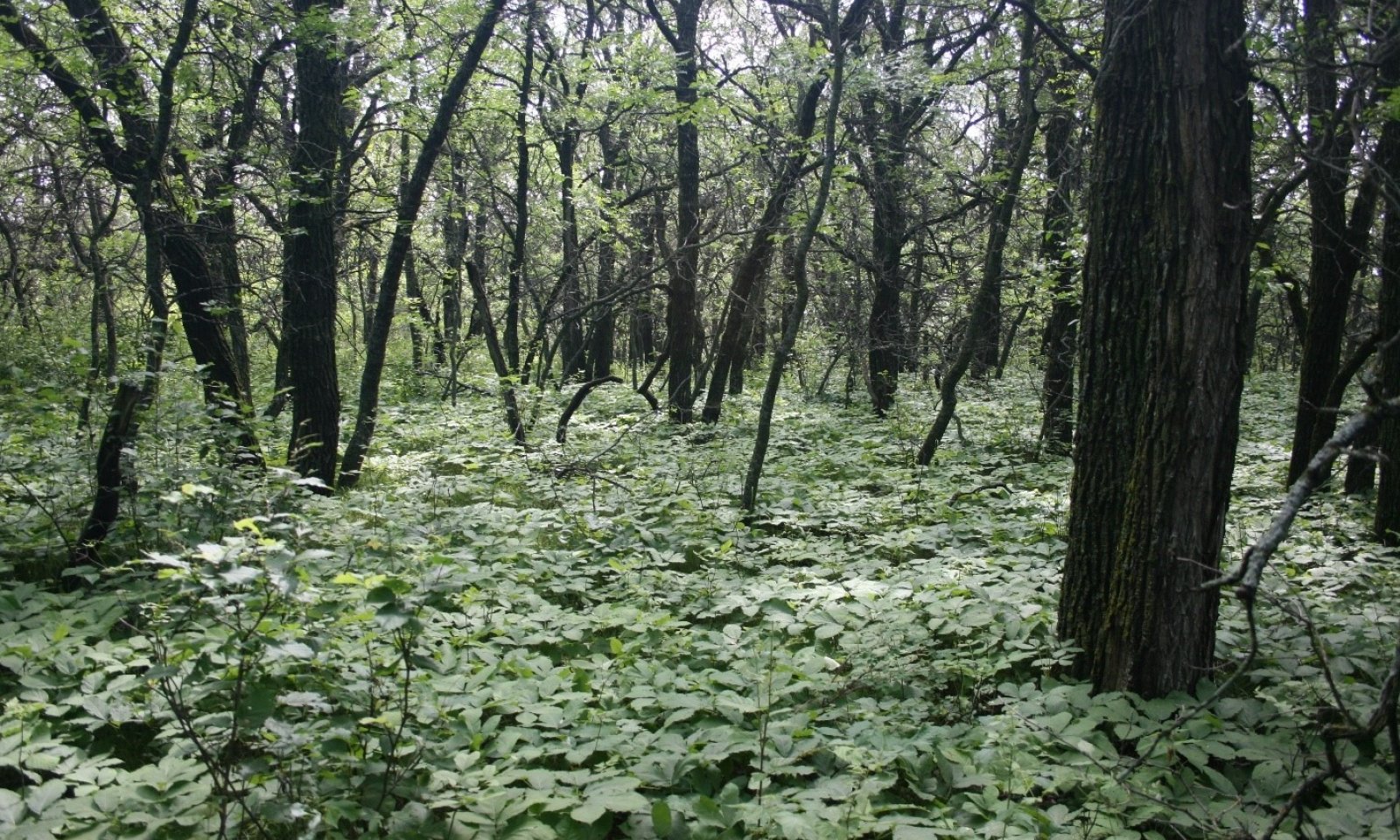
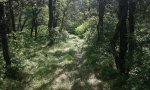
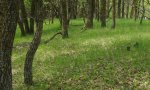
This state forms outside the historical disturbance regime, largely because of the long-term elimination of fire sufficient to establish a bur oak dominated forest similar to that of 1.3, and the introduction of exotic cool-season grasses. This state may be described as a bur oak dominated woodland with green ash and quaking aspen as the principal associates. The shrub component may include American and beaked hazel, chokecherry, Saskatoon serviceberry, rose, and snowberry. Kentucky bluegrass and/or smooth brome are the main cool-season exotic grasses, while the native graminoid component is largely limited to Sprengel’s sedge and perhaps rough ricegrass. Common associated forbs include wild sarsaparilla, early meadow-rue, veiny pea, and starry false lily of the valley.
Presently the distribution of common buckthorn in MLRA 55A has been relatively limited. However, it is spreading, and due to its invasive nature and habit of displacing native understory species is a threat to biodiversity. As a result, periodic monitoring for the species is recommended, and if the plant is encountered, control measures implemented.
Characteristics and indicators
The presence of trace amounts of exotic cool-season grasses. The presence of exotic biennial or perennial forbs (e.g. common dandelion, red clover, white clover, and black medic may not, on their own, indicate a transition from State 1: Reference State to State 2: Native/Invaded State but may facilitate that transition.
Resilience management
The invasion of these exotic grasses is associated with long-term elimination of fire allowing bur oak and green ash to dominate. These fire tolerant species will not be significantly impacted by implementation of prescribed fire. To maintain State 2.0 Native/Invaded State prescribed fire and prescribed grazing should be implemented.
Submodel
Description
This state results from clearing of woody vegetation on the site regardless of technique, and perhaps followed by a successful seeding of the site to native and/or introduced grasses, with or without introduced legumes or native forbs.
Characteristics and indicators
The plant community is a result of successful woody vegetation clearing or after pasture and hayland or rangeland planting. Exotic grasses, native grasses, exotic legumes, and or native forbs are used for grazing or forage production.
Resilience management
To slow or limit the invasion woody species, it is imperative that managerial options (e.g. prescribed grazing, prescribed burning) be carefully constructed and evaluated with respect to that objective).
Grazing management should be applied that enhances the competitive advantage of native grass and forb species. This may include: (1) grazing when exotic cool-season grasses are actively growing and native cool-season grasses are dormant; (2) applying proper deferment periods allowing native grasses to recover and maintain or improve vigor; (3) adjusting overall grazing intensity to reduce excessive plant litter (above that needed for rangeland health indicator #14 – see Rangeland Health Reference Worksheet); (4) incorporating early heavy spring utilization which focuses grazing pressure on exotic cool-season grasses and reduces plant litter provided that livestock are moved when grazing selection shifts from exotic cool-season grasses to native grasses.
Prescribed burning should be applied in a manner that maintains or enhances the competitive advantage of native grass and forb species. Prescribed burns should be applied as needed to adequately reduce/remove excessive plant litter and maintain the competitive advantage for native species. Timing of prescribed burns (spring vs. summer vs. fall) should be adjusted to account for differences in annual growing conditions and applied during windows of opportunity to best shift the competitive advantage to the native species.
Submodel
Description
This state typically results from the abandonment of cropland, hayland, or residences/farmsteads. Vegetation is typically dominated by Kentucky bluegrass and smooth brome. Common associates include western snowberry, wild rose, northern bedstraw, common dandelion, Canada goldenrod, common yarrow, and Canada thistle. Sprouts from adjacent stands of aspen or beaked hazel often encroach onto the site, as well as seedlings of adjacent green ash.
Characteristics and indicators
Tillage has destroyed the native plant community, altered soil structure and biology, reduced soil organic matter, and resulted in the formation of a tillage induced compacted layer which is restrictive to root growth. Noxious weeds, if present, will need to be managed.
Resilience management
Continued tillage will maintain the state. Control of noxious weeds will be required.
Submodel
Mechanism
This is the transition from State 1: Reference State to State 2: Native/Invaded State due to the introduction and establishment of exotic cool-season grasses. This transition is partially attributable to decades of fire suppression and other environmental factors outside the historical disturbance regime.
Constraints to recovery
Current knowledge and technology will not facilitate a successful restoration to Reference State.
Mechanism
This transition from State 2: Native/Invaded State to State 3: Grassland State may be initiated by the clearing cutting/brush management and allowing grasses and other herbaceous vegetation to dominate site.
Constraints to recovery
Labor and financial cost of removal/control of woody species. Exotic herbaceous species, resprouting shrubs and stumps, and annual/pioneering exotics will quickly populate the site.
Mechanism
This transition from State 2: Native/Invaded State to State 4: Go-Back State may be initiated by the clearing of the woody vegetation and stump removal for annual cropping followed by cropland abandonment.
Constraints to recovery
Labor and financial cost of removal/control of woody species to cropland will be dependent on the conversion duration. Time constraints and cost factors make restoration improbably. Technology limitations will also play a role.
Mechanism
This restoration pathway from State 3: Grassland State to State 2: Native/Invaded State may be accomplished with a successful forestry planting or secondary succession.
Context dependence
Labor, time, and expense, along with long term management needs via forest plantings may limit success.
Mechanism
This restoration from State 4: Go-Back State to State 2: Native/Invaded State may be initiated when a forest planting is conducted, or secondary succession occurs to restore the Native/Invaded
Context dependence
Labor, time, and expense, along with long term management needs via R4A may limit success.
Mechanism
This restoration from State 4: Go-Back State to State 3: Grassland State may be initiated when a successful pasture or hayland planting is completed. Prescribed grazing and/or prescribed burning will be necessary to complete the restoration.
Context dependence
A successful pasture and hayland or range planting will include proper seedbed preparation, weed control (both prior to and after the planting), selection of adapted native species, and proper seeding technique. Management (e.g. prescribed grazing, prescribed burning) during and after establishment must be applied in a manner that maintains the competitive advantage for the seeded species.
The method or methods of herbaceous weed treatment will be site specific to each situation; but generally, the goal would be to apply the pesticide, mechanical control or biological control - either singularly or in combination - in a manner that shifts the competitive advantage from the targeted species to the native grasses and forbs. The control method(s) should be as specific to the targeted species as possible to minimize impacts to non-target species.
Mechanism
his transition from any plant community to State 4: Go-Back State. It is most commonly associated with the cessation of cropping without the benefit of range planting, resulting in a “go-back” situation. Soil conditions can be quite variable on the site, in part due to variations in the management/cropping history (e.g., development of a tillage induced compacted layer (plow pan), erosion, fertility, and/or herbicide/pesticide carryover). Thus, soil conditions should be assessed when considering restoration techniques.
Model keys
Briefcase
Add ecological sites and Major Land Resource Areas to your briefcase by clicking on the briefcase ( ) icon wherever it occurs. Drag and drop items to reorder. Cookies are used to store briefcase items between browsing sessions. Because of this, the number of items that can be added to your briefcase is limited, and briefcase items added on one device and browser cannot be accessed from another device or browser. Users who do not wish to place cookies on their devices should not use the briefcase tool. Briefcase cookies serve no other purpose than described here and are deleted whenever browsing history is cleared.
Ecological sites
Major Land Resource Areas


The Ecosystem Dynamics Interpretive Tool is an information system framework developed by the USDA-ARS Jornada Experimental Range, USDA Natural Resources Conservation Service, and New Mexico State University.