


Bald Knob Dolomite Glade


Scenario model
Current ecosystem state
Select a state


Management practices/drivers
Select a transition or restoration pathway
- Transition T1A More details
- Transition T1B More details
- Restoration pathway R2A More details
- Transition T2A More details
- Restoration pathway R3A More details
-
No transition or restoration pathway between the selected states has been described
Target ecosystem state
Select a state
State 1
Reference
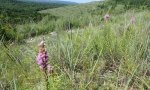


Description
Compared to other ecological sites in the Ozarks, Bald Knob Dolomite Glade remnants are common, and in many cases have retained much of their ecological health and quality. The reference state ranges from wide open grassy areas with shallow soils and bare bedrock, to areas with widely scattered chinkapin oak and post oak on locations with soil depths at the deeper extreme of the range for this soil component. On protected slopes and along the outer edges of glades, open woodlands are more common but glades on protected slope still do occur. Periodic disturbances from fire (Guyette and McGinnes, 1982) maintain the dominance of drought adapted native grasses and forbs by limiting the growth and dominance of trees, especially eastern redcedar. Long disturbance-free periods allow an increase in woody species.
Maintaining existing glade connectivity (e.g., preventing further glade habitat loss) and increasing landscape connectivity through the restoration of degraded glades will improve conditions for healthy glades. Prescribed fire is an important management tool for maintaining this open and connected glade landscape (Miller et al., 2015) although many of these glade communities are stable and self-assembling intact systems even with infrequent fire (NatureCITE, 2021).
Illegal digging of glade plants and collection of animals is also resulting in the degradation of quality glades. Collectors turn over large boulders and ledge rock (Figure 17; photo credit MDC) to gather invertebrates, snakes, and lizards. Digging in glades to collect plants steadily exposes fragile, thin, organic soil, causing erosion and leaving behind more acid gravel and rock debris. Plant species diversity and cover are diminished, and recovery is slow or permanently altered because of drought conditions and species depletion (Nelson et. al.,2013).
Two community phases are recognized in this state, with shifts between phases based on fire frequency.
Submodel
Description
This state and community phase is dominated by eastern redcedar due to extended or permanent periods of fire suppression (Figure 18). This state can form relatively even-age stands, dating to when fire suppression began, often coupled with removal of livestock. This stage can occur relatively quickly (15 to 20 years). Over time, canopy closures can approach 60 to 80 percent with little or no ground flora under the overstory canopy. Without active management, such as prescribed fire and woody removal, these sites will continue increasing in canopy coverage except on the shallowest soil and open bedrock areas where droughty conditions often keep woody invasion in check. Most Bald Knob Dolomite Glade ecological sites throughout its range are currently in this state.
Submodel
Description
Decades of overgrazing (Figure 20) have eroded the shallow, fragile, original soil layer from glades (Nelson and Ladd, 1980; Erickson et al.,1942). This overgrazing has decreased the number and diversity of species and has caused changes in the distribution of opportunistic and conservative glade species. Grazing activities reduce the quality of glade habitats through soil compaction and the selective removal of plant species. Two phases occur in this state with shifts between phases based on intensity of grazing and management inputs.
Submodel
Mechanism
This gradual transition to a Woody Invaded Glade state results from prolonged periods of fire suppression, generally over 20 years. Sites in this condition may also have received historic cattle grazing, adding to the potential for eastern redcedar invasion and site disturbance.
Mechanism
Transition to a Grazed Glade state results from persistent grazing by domestic livestock accompanied by fire suppression, woody invasion or woody clearing and conversion to non-native, cool-season pasture.
Mechanism
This reference state restoration pathway requires removal of most of the invading woody species such as eastern redcedar, accompanied by prescribed fire on a continuing basis.
Relevant conservation practices
| Practice | External resources |
|---|---|
|
Brush Management |
|
|
Prescribed Grazing |
|
|
Restoration and Management of Rare and Declining Habitats |
Mechanism
This transition to a Grazed Glade state results from prolonged periods of fire suppression and the introduction of grazing by domestic livestock. These dynamics are also often accompanied by reseeding with non-native grasses creating soil disturbance to support modern grazing systems.
Mechanism
This reference state restoration pathway requires exclusion of livestock grazing, accompanied by prescribed burning and brush management. The infestations of invasive plant species can be controlled using integrated techniques which include woody removal, the selective use of herbicides and prescribed fire. Reseeding with native grasses and forbs may be necessary to off-set severe infestations of exotic plants or opportunistic native woody species. If grazing activities have been extensive for long periods of time, recovery to a reference state may be impossible.
Relevant conservation practices
| Practice | External resources |
|---|---|
|
Brush Management |
|
|
Prescribed Grazing |
|
|
Restoration and Management of Rare and Declining Habitats |
Model keys
Briefcase
Add ecological sites and Major Land Resource Areas to your briefcase by clicking on the briefcase ( ) icon wherever it occurs. Drag and drop items to reorder. Cookies are used to store briefcase items between browsing sessions. Because of this, the number of items that can be added to your briefcase is limited, and briefcase items added on one device and browser cannot be accessed from another device or browser. Users who do not wish to place cookies on their devices should not use the briefcase tool. Briefcase cookies serve no other purpose than described here and are deleted whenever browsing history is cleared.
Ecological sites
Major Land Resource Areas


The Ecosystem Dynamics Interpretive Tool is an information system framework developed by the USDA-ARS Jornada Experimental Range, USDA Natural Resources Conservation Service, and New Mexico State University.