


Hillside Seep

Scenario model
Current ecosystem state
Select a state
Management practices/drivers
Select a transition or restoration pathway
-
Transition T1A
Fire exclusion or reduced fire frequency (~10 to 20-year return interval).
More details -
Transition T2A
Prescribed burns and selective removals, with increased fire frequency thereafter (< 10-year return interval).
More details -
Transition T2B
Continued exclusion of fire or reduced fire frequency (≥ 20-year return interval).
More details -
Transition T3A
Stand replacing disturbance, increased fire frequency (< 10-year return interval), and natural succession.
More details -
Transition T3B
Prescribed burns and selective removals, with increased fire frequency thereafter (< 20-year return interval).
More details -
No transition or restoration pathway between the selected states has been described
Target ecosystem state
Select a state
Description
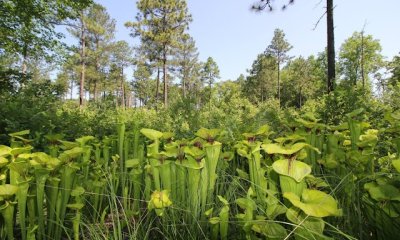
Hillside seeps are dynamic systems, undergoing considerable change over time in response to natural disturbances. Shrubs expand and contract as cycles of drought give rise to differential penetration of fire, allowing shrub and herb cover to expand and contract over time.
Characteristics and indicators
Although rarely abundant, emergent trees may be present in small numbers. The most common species overall is pond pine (Pinus serotina). If present, trees are usually widely spaced or confined to the wetter, innermost zone.
Submodel
Description
This state begins to develop with reduced fire frequency (~10 to 20 years). In response, cover from trees begins to increase, with pond pine (Pinus serotina) typically being the most common species. Other important species that begin to establish include sweetbay (Magnolia virginiana), swamp bay (Persea palustris), red maple (Acer rubrum), and tuliptree (Liriodendron tulipifera), among others. Scattered longleaf pines may also be present. Shrub cover is dense in the understory and herb cover is sparse (Sutter and Kral 1994; USFWS 2010, 2014).
Description
In this closed canopy state, the canopy is dominated by hardwoods that have come in after prolonged periods without fire (≥ 20 years of fire exclusion). In the absence of fire, ecological dynamics are driven largely by canopy gaps caused by windthrow.
Mechanism
The reference state can transition to the pond pine seepage woodland with ongoing exclusion of fire or reduced fire frequency (~10 to 20-year return interval). Under these conditions, cover from tree species begins to increase.
Mechanism
Pond pine seepage woodlands can transition back to the reference state through a combination of prescribed burns and selective removals. For long-term maintenance of the reference state, increased fire frequency (< 10-year return interval) will be needed thereafter. Warm season burns are most effective as a restoration tool.
Though increased fire frequency is a critical part of restoration, fire alone is not usually sufficient to overcome the threshold needed to reestablish the unique ecological dynamics that characterize the reference state, wherein vegetation structure moves fluidly between shrub and herb dominance with fire.
Mechanism
In the absence of fire, or with reduced fire frequency (≥ 20-year return interval), pond pine seepage woodlands can succeed to forest.
Mechanism
Over time, the hillside seepage forest state can transition back to the reference state through a stand replacing disturbance (clear-cutting, catastrophic fire, etc.) followed by an increase in the frequency of fire (< 10-year return interval). This is a gradual process, as it can take a number of years to ameliorate the effects of long-term fire suppression, and many more to approximate the composition and diversity of species observed under reference conditions.
Constraints to recovery
Because forest patches associated with this ecological site are typically small and insular, seed sources for characteristic seep species tend to be scarce in the surrounding landscape. Recovery can be hastened to some extent by planting keystone species.
Mechanism
The hillside seepage forest state can transition to the pond pine seepage woodland through prescribed burns, and if necessary, selective removals. Conditions needed to carry fire may take a number of years to restore. Increased fire frequency (< 20-year return interval) will be needed for long-term maintenance thereafter. Warm season burns are most effective as a restoration tool.
Model keys
Briefcase
Add ecological sites and Major Land Resource Areas to your briefcase by clicking on the briefcase ( ) icon wherever it occurs. Drag and drop items to reorder. Cookies are used to store briefcase items between browsing sessions. Because of this, the number of items that can be added to your briefcase is limited, and briefcase items added on one device and browser cannot be accessed from another device or browser. Users who do not wish to place cookies on their devices should not use the briefcase tool. Briefcase cookies serve no other purpose than described here and are deleted whenever browsing history is cleared.
Ecological sites
Major Land Resource Areas


The Ecosystem Dynamics Interpretive Tool is an information system framework developed by the USDA-ARS Jornada Experimental Range, USDA Natural Resources Conservation Service, and New Mexico State University.