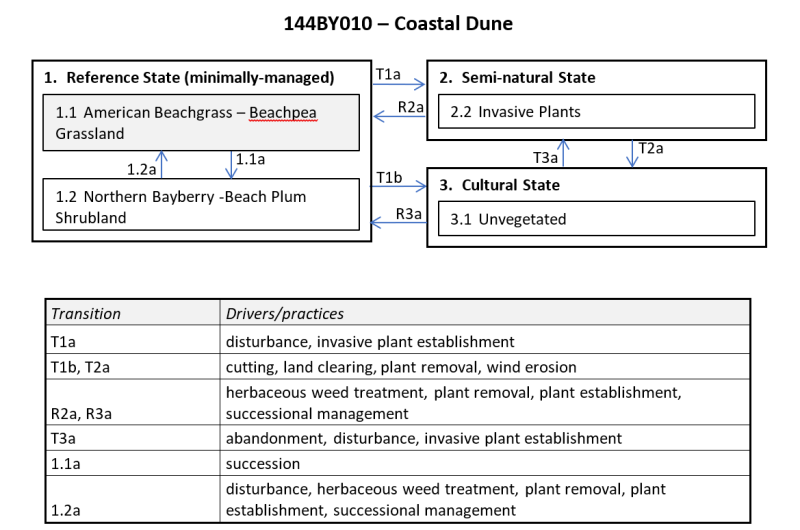
Ecological dynamics
Ecological Dynamics
[Caveat: The vegetation information contained in this section is only provisional, based on concepts, not yet validated with field work.*]
The vegetation groupings described in this section are based on the terrestrial ecological system classification and vegetation associations developed by NatureServe (Comer et al., 2003). Terrestrial ecological SYSTEMS are specifically defined as a group of plant community types called ASSOCIATIONS that tend to co-occur within landscapes with similar ecological processes, substrates, and/or environmental gradients. They are intended to provide a classification unit that is readily mappable, often from terrain and remote imagery, and readily identifiable by conservation and resource managers in the field. A given system will typically manifest itself in a landscape at intermediate geographic scales of tens-to-thousands of hectares and will persist for 50 or more years. A vegetation association is a plant community that is much more specific to a given soil, geology, landform, climate, hydrology, and disturbance history. It is the basic unit for vegetation classification and recognized by the US National Vegetation Classification (FDGC, 2008; USNVC, 2017). Each association will be named by the diagnostic and often dominant species that occupy the different height strata (represented by tree, shrub, and herb layers). Within the NatureServe Explorer database, ecological systems are numbered by a community Ecological System Code (CES) and individual vegetation associations are assigned an identification number called a Community Element Global Code (CEGL).
Th maritime Coastal Dune ecological site is characterized by a mix of xeric plant communities coinciding Northern Atlantic Coastal Plain Dune and Swale system (CES203.264). The prevailing ecological processes are due to the exposed maritime environment, including frequent salt spray, wind exposure, sand abrasion, high light intensity, overwash, and sand movement. Other disturbances considered as threats include: development and fragmentation, barriers to connectivity to the open ocean, off-road vehicles, trampling, occasional fire, and accelerated sea-level rise. Invasive plants include rugosa rose (Rosa rugosa) and beach wormwood (Artemisia stelleriana).
Plant community succession on the site coincides with coastal dune succession. Young, active foredunes, are nearest the ocean in the most exposed environments. Interspersed with small to large areas of bare sand, the vegetation on the young dunes is a Northern Beach Dune (CEGL006274) dominated by American beachgrass (Ammophila breviligulata). A mid-seral are plant community occurring on more stabilized dunes is the Northern Bayberry Dune Shrubland (CEGL006295) dominated by northern bayberry (Morella pensylvanica) and the rare but diagnostic, beach plum (Prunus maritima). On older and more stabilized backdunes or secondary dunes, occurs the Pitch Pine Maritime Dune Woodland (CEGL006117) dominated by pitch pine (Pinus rigida) and woolly beach heather (Hudsonia tomentosa) and northern bayberry (Morella pensylvanica).
Additional and more localized vegetation information can be provided by the various State Heritage Programs. Additional insights to the vegetation were provided by Natural Landscapes of Maine: A Guide to Natural Communities and Ecosystems (Grawler and Cutko, 2010).
Beyond the reference state, other ecological states, a Semi-natural State and a Cultural State are often recognized. The Semi-natural State would expect plant communities where ecological processes primarily operate with some conditioning by land management, e.g., managed forests, or plant communities that are an artifact of land management e.g., predominately invasive plants. The Cultural State is a completely converted or transformed state; heavily or completely conditioned by land management, e.g., cultivated lands, pasture/haylands, vineyards, and plantations, etc. Generally, the form of vegetation in the Semi-natural State or the Cultural State is not able to be specified until field work is conducted.
[*Caveat] The vegetation information presented is representative of complex plant communities. Key indicator plants and ecological processes are described to help inform land management decisions. Plant communities will differ across the MLRA because of the naturally occurring variability in weather, soils, and geography. The reference plant community is not necessarily the management goal. The drafts of species lists are merely representative and are not botanical descriptions of all species occurring, or potentially occurring, on this site. They are not intended to cover every situation or the full range of conditions, species, and responses for the site.
State 1
Reference State - Coastal Dune
This ecological site is characterized by a mix of xeric plant communities coinciding Northern Atlantic Coastal Plain Dune and Swale system (CES203.264) (NatureServe 2022).
The predominant reference plant community is largely herbaceous:
• Northern Beachgrass Dune, (American Beachgrass - Beach Pea Grassland, [Ammophila breviligulata Grassland] - CEGL006274); and under stable dune conditions, it may succeed to shrublands, predominantly:
• Northern Bayberry Dune Shrubland (Northern Bayberry - BeachPlum Shrubland, [Morella pensylvanica - Prunus maritima Shrubland] – CEGL006295).
Other less common associated plant communities include:
• Northern Beach-heather Dune Dwarf-shrubland (Woolly Beach-heather - Bearberry Dwarf-shrubland [Hudsonia tomentosa - Arctostaphylos uva-ursi Dwarf-shrubland] – CEGL006143), and
• Pitch Pine Maritime Dune Woodland (Pitch Pine / Woolly Beach-heather Woodland [Pinus rigida / Hudsonia tomentosa Woodland] - (CEGL006117).
[Source: NatureServe 2022, USNVC 2022]
Community 1.1
Northern Beachgrass Dune
Northern Beachgrass Dune, (American Beachgrass - Beach Pea Grassland, [Ammophila breviligulata - Lathyrus japonicus Grassland] - CEGL006274) is the typical community type. This association is characterized and dominated by American beechgrass (Ammophila breviligulata), which is often the only plant present, especially on foredunes or other areas of active and rapid sand deposition. Beach pea (Lathyrus japonicus) is the most common associate and sometimes codominant. Other associated species include the American red raspberry (Rubus idaeus), and gooseberries (Ribes sp.). Additional plants of more stabilized dunes include beach pinweed (Lechea maritima), little bluestem (Schizachyrium scoparium), Virginia wildrye (Elymus virginiana var. halophilus), beach sedge (Carex silicea), coastal jointweed (Polygonella articulata), and oldwoman/dusty miller (Artemisia stelleriana). Dwarf-shrubs, such as wooly beach heather (Hudsonia tomentosa), beach rose (Rosa rugosa), northern bayberry (Morella pensylvanica [= Myrica pensylvanica]), or stunted beach plum (Prunus maritima), and poison ivy (Toxicodendron radicans) can occur sporadically and form patches within the grassland. [Source: NatureServe, 2022, USNVC, 2022].
Cross-referenced plant community concepts (typically by political state):
Dune Grassland (Grawler and Cutko 2010 ) [ME]
Community 1.2
Northern Bayberry Dune Shrubland
Northern Bayberry Dune Shrubland (Northern Bayberry – Beach Plum Shrubland, [Morella pensylvanica - Prunus maritima Shrubland] – CEGL006295) typically occurs on more stabilized dunes. Northern bayberry (Morella pensylvanica [= Myrica pensylvanica] dominates, with an often codominant shrub, rugosa rose(Rosa rugosa), while not native, where naturalized it’s restricted to duneland sites. Often considered diagnostic, but uncommon, is beach plum (Prunus maritima). Other common shrubs or stunted trees in less abundance can include: northern bush honeysuckle (Diervilla lonicera), and sporadic red cedar (Juniperus virginiana) and black cherry (Prunus serotina). The herbaceous layer tends to be sparse where shrub growth is dense, and can include dune grassland species: American beachgrass (Ammophila breviligulata), American red raspberry (Rubus idaeus), seaside goldenrod (Solidago sempervirens), wooly beach heather (Hudsonia tomentosa), beach pinweed (Lechea maritima),Greene’s rush (Juncus greenei), seabeach sedge (Carex silicea), coastal jointweed (Polygonella articulata), seacoast angelica (Angelica lucida) or occasionally adjacent upland species such as, common wrinkleleaved goldenrod (Solidago rugosa ssp. aspera), small flowered evening primrose (Oenothera parviflora), little bluestem (Schizachyrium scoparium), and others. Typical vine associates are poison ivy (Toxicodendron radicans). Open, bare patches to sparsely-vegetated sand are present in some examples [Source: NatureServe 2022, USNVC 2022].
Cross-referenced plant community concepts (typically by political state):
Rose Maritime Shrubland (Grawler and Cutko, 2010) [ME]
Pathway 1.1A
Community 1.1 to 1.2
succession, dune stabilization
Pathway 1.2A
Community 1.2 to 1.1
Disturbance, plant removal, vegetation management
State 2
Semi-natural State
Semi-natural dunescapes may be dominated by occasional non-native plants including dustymiller/oldwoman (Aretemisia stelleriana), rugosa rose (Rosa rugosa), and Morrow's honeysuckle (Lonicer morrowii).
Community 2.1
Invasive plant community
Rugosa rose (Rosa rugosa)
State 3
Cultural State
Cultural States are highly transformed by land use conditioning.
Community 3.1
Unvegetated
Unvegetated dunes due to clearing or trampling.
Transition T1A
State 1 to 2
Disturbance, invasive plant establishment
Transition T1B
State 1 to 3
Clearing, trampling
Restoration pathway R2A
State 2 to 1
Herbaceous weed treatment, plant removal, plant establishment, successional management
American beachgrass (Ammophila breviligulata) plugs generally planted on a grid (0.5 m on center?)
Transition T2A
State 2 to 3
Plant removal, clearing
Restoration pathway R3A
State 3 to 1
Plant establishnt, vegetation management
Transition T3A
State 3 to 2
Invasive plant establishment, disturbance