


Natural Resources
Conservation Service
Ecological site VX165X01X001
Isothermic Ustic Naturalized Grassland
Last updated: 5/08/2025
Accessed: 03/04/2026
General information
Provisional. A provisional ecological site description has undergone quality control and quality assurance review. It contains a working state and transition model and enough information to identify the ecological site.
MLRA notes
Major Land Resource Area (MLRA): 165X–Subhumid Intermediate Mountain Slopes
This MLRA occurs in the State of Hawaii on the islands of Molokai, Oahu, and Kauai. Elevation ranges from 400 to 3,700 feet (120 to 1,130 meters). It is on leeward, drier, intermediate mountain slopes on rolling slopes that are dissected by many steep and very steep gulches. The geology is basic igneous rock (primarily basalt). Interfluves are influenced volcanic ash. Average annual precipitation ranges from 25 to 60 inches (635 to 1,525 millimeters). Most of the rainfall occurs from November through March. Average annual air temperature is 61 to 74 degrees F (16 to 23 degrees C), with little seasonal variation. Dominant soils are Inceptisols, Ultisols, Oxisols, Andisols, and Spodosols with an isothermic, soil temperature regime and ustic or udic soil moisture regimes. Vegetation consists of forest, grassland, and shrubland.
Classification relationships
This ecological site occurs within Major Land Resource Area (MLRA) 165 - Subhumid Intermediate Mountain Slopes.
Ecological site concept
This ecological site is largely naturalized grassland at low elevations on leeward Kauai, leeward Molokai, and a small area on the West Maui Mountains. Principal landowners are private land companies, ranches, and the State of Hawaii. It is accessible on Kauai along Route 550 above Waimea, on Molokai along Route 470, and along Route 340 northwest of Kahului.
The central concept of the Isothermic Ustic Naturalized Grassland is of well drained, moderately deep to very deep soils, mostly with humic or umbric (high organic matter but often low base saturation) properties that formed in residuum from basic igneous rock, in some cases with an overlayer of volcanic ash. Annual air temperatures and rainfall are associated with warm (isothermic), seasonally dry (ustic) soil conditions. Elevations range from 500 to 2500 feet (155 to 770 meters); extremes are as low as 200 feet (60 meters) and as high as 3400 feet (1045 meters). Because very little of the original native vegetation remains, the reference state of this ecological site consists of the dominant naturalized grassland vegetation. While the dominant grass species is kikuyugrass (Cenchrus clandestinus (syn. Pennisetum clandestinum)), guineagrass (Urochloa maxima) is abundant at moderate elevations and buffelgrass can occur onthe lowest leeward extremes. Common naturalized trees are christmasberry (Schinus terebinthifolius) and haole (Leucaena leucocephala). The original native vegetation was dry to transitionally moist forest, which is often referred to as “mesic forest” in botanical literature. Common species, based on the current environment and remnant occurrences, were ohia lehua (Metrosideros polymorpha), olopua (Nestegis sandwicensis), lama (Diospyros sandwicense), alahee (Psydrax odorata), naio (Myoporum sandwicense), koaia (Acacia koaia), aalii (Dodonaea viscosa), pukiawe (Leptecophylla (Styphelia) tameiameiae), ulei (Osteomeles anthyllidifolia), and huehue (Cocculus orbiculatus).
Associated sites
| VX158X01X002 |
Isohyperthermic Torric Naturalized Grassland Kiawe/buffelgrass (Prosopis pallida/Pennisetum ciliare) The Isohyperthermic Torric Naturalized Grassland has a warmer, drier climate, different plant species, and lower annual aboveground production than this ecological site. |
|---|---|
| VX158X01X004 |
Rocky Isohyperthermic Torric Naturalized Grassland Kiawe/uhaloa/buffelgrass (Prosopis pallida/Waltheria indica/Pennisetum ciliare) The Rocky Isohyperthermic Torric Naturalized Grassland has a warmer, drier climate, lower water holding capacity in the soil, different plant species, and lower annual aboveground production than this ecological site. |
| VX158X01X005 |
Naturalized Grassland 50 to 90 inch PZ Ohia lehua/kikuyugrass (Metrosideros polymorpha/Pennisetum clandestinum) The Naturalized Grassland 50 to 90 Inch Precipitation Zone has a cooler, moister climate, different plant species, and higher annual aboveground productiion than this ecological site. |
| VX165X01X002 |
Cool Isothermic Udic Forest The Cool Isothermic Udic Forest occurs with this ecological site on Kauai, but it is at higher, cooler, moister elevations. |
Similar sites
| VX161A01X009 |
Isothermic Ustic Naturalized Grassland Isothermic Naturalized Grassland (R161AY009HI) occurs only on the island of Hawaii. It is more broadly defined than this ecological site, occurring over a wider range of rainfall and elevaions. The two ecological sites overlap in species occurrences and production. |
|---|---|
| VX166X01X002 |
Isothermic Ustic Naturalized Grassland Isothermic Ustic Naturalized Grassland (R166XY002HI) occurs on Lanai and Molokai. It has generally lower precipitation, shares many plant species, and has lower production than this ecological site. |
Table 1. Dominant plant species
| Tree |
(1) Leucaena leucocephala |
|---|---|
| Shrub |
Not specified |
| Herbaceous |
(1) Pennisetum clandestinum |
Legacy ID
R165XY001HI

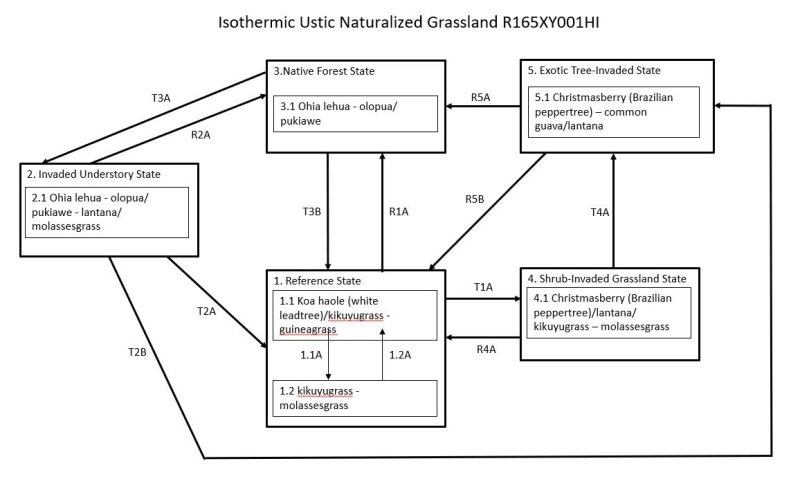


Click on box and path labels to scroll to the respective text.
Ecosystem states
States 1, 5 and 2 (additional transitions)
| R1A | - | It is possible to restore State 1 Reference to a plant community resembling State 3 Native Forest. Weed control must be applied to forage species and the many opportunistic plant species that would invade the site. Weed control would be a perpetual process to maintain the site. Fire must be excluded. Domestic and feral ungulates must be excluded by a suitably designed and maintained fence. Extensive planting of native species would follow. |
|---|---|---|
| T1A | - | State 1 Reference transitions to State 4 Shrub Invaded Grassland through further overgrazing or abandonment. Fire will temporarily prevent this transition. Koa haole will be greatly reduced by over browsing. If the site contained abundant koa haole and was then abandoned, these small trees can greatly increase in abundance. Otherwise, there is gradual invasion by weedy shrubs and small trees. |
| T2A | - | State 2 Invaded Understory transitions to State 1 Reference by land clearing with heavy machinery followed by weed control. Land clearing can promote germination of the weed seed bank in the soil, requiring weed control. After clearing and weed control, the site would be planted to forage species. |
| R2A | - | State 2 Invaded Understory may be restored to a facsimile of State 3 Native Forest State, by removal of the introduced understory through weed control measures. Reintroduction of native understory species is required. The site must be fenced securely to exclude ungulates. |
| T2B | - | State 2 Invaded Understory transitions to State 5 Exotic Tree Invaded by growth of introduced tree species through and above the native canopy. Lack of reproduction leads to gradual loss of most native plants. |
| T3B | - | State 3 Native Forest transitions to State 1 Naturalized Grassland by clearing the forest and planting desirable forage species. |
| T3A | - | State 3 Native Forest State transitions to State 2 Invaded Understory through grazing, browsing, rooting, and trampling by domestic or feral ungulates (cows, sheep, deer, goats, and pigs). These activities destroy small native plant species and seedlings and saplings of large species. Regeneration of the native forest is prevented, leading to tree populations consisting almost entirely of mature plants. Lack of competition from native plants, introduction of weed seeds, and disturbance of the soil lead to an understory dominated by introduced plant species. Weeds can invade intact native forest even in the absence of ungulates and gradually bring about the transition. Invasive vines, shrubs, and small trees will grow under intact native canopies and begin to degrade the forest. Eventually, introduced grasses provide fine fuels that can carry intense fires that destroy the native tree canopy. |
| R4A | - | State 4 Exotic Tree Invaded State can be restored to State 1 Reference by brush management with follow-up control of re-sprouting shrubs and emerging weedy forbs. Forage species may be replanted and maintained by prescribed grazing. |
| T4A | - | State 4 Shrub Invaded Grassland transitions to State 5 Exotic Tree Invaded with lack of fire. Fast-growing introduced tree species invade Shrub Invaded Grassland and overtop shrubs, or christmasberry increases in stature and density to become dominant. |
| R5B | - | State 5 Exotic Tree Invaded State may be restored to State 1 Reference. Total clearing of the site would be necessary. If clearing is done by heavy machinery, soil disturbance would occur. This would probably induce germination of the weed seed bank and also increase the potential for soil erosion. Weed control and brush management must then be applied multiple times to control new weed germination and resprouting. After clearing and weed control, the site would be planted to forage species. Ungulates must be excluded until forages are well established; prescribed grazing must then be applied. |
| R5A | - | It may be possible to restore State 5 Exotic Tree Invaded to a community resembling State 3 Native Forest. Total clearing of the site would be necessary. Alternatively, it may be worthwhile to kill taller weed species in place in order to provide some shelter for the ground. If clearing is done by heavy machinery, soil disturbance would occur. This could induce germination of the weed seed bank and also increase the potential for soil erosion. Weed control would be ongoing. Protection from fire is needed, and ungulates must be excluded by a suitable fence. |
State 1 submodel, plant communities
| P1.1A | - | Community phase 1.1 converts to phase 1.2 by continuous grazing without adequate rest for preferred forages. This conversion can be avoided by timely application of deferred and/or prescribed grazing to allow recovery of desirable species after grazing or browsing. |
|---|---|---|
| P1.2A | - | Community phase 1.1 converts to phase 1.2 by continuous grazing without adequate rest for preferred forages. This conversion can be avoided by timely application of deferred and/or prescribed grazing to allow recovery of desirable species after grazing or browsing. |