


Natural Resources
Conservation Service
Ecological site VX166X01X501
Placorthod Forest
Last updated: 5/08/2025
Accessed: 04/08/2026
General information
Provisional. A provisional ecological site description has undergone quality control and quality assurance review. It contains a working state and transition model and enough information to identify the ecological site.
MLRA notes
Major Land Resource Area (MLRA): 166X–Very Stony Land and Rock Land
This MLRA occurs in the State of Hawaii on the islands of Maui, Kahoolawe, Lanai, Molokai, Oahu, Kauai, and Niihau. Elevation ranges from sea level to 8,000 feet (0 to 2,440 meters). The terrain encompasses stony complex slopes and rocky gulches (USDA-NRCS, 2006). The geology is extrusive basic igneous rock (primarily basalt) that are weathered in some areas. Some interfluves are mantled with weathered volcanic ash. Average annual precipitation ranges from 17 to 39 inches (430 to 990 millimeters) (Giambelluca et al., 2013). Extreme average annual precipitation ranges from 10 to 107 inches (254 to 2,720 millimeters). Most of the rainfall occurs from November through March, much of it during kona storms. Average annual air temperatures ranges from 70 to 75 degrees F (21 to 24 degrees C) with little seasonal variation (Giambelluca et al., 2014). Extreme annual air temperatures range from 48 to 82 degrees F (9 to 28 degrees C). Dominant soils are Mollisols, Aridisols, and Entisols with an isohyperthermic, isothermic, or isomesic soil temperature regimes and ustic or aridic soil moisture regimes (USDA-NRCS, 2006). Vegetation consists of forbs, grasses, and shrubs with some trees. Most of the plant species typically encountered are introduced species that have become naturalized in Hawaii. However, areas within this MLRA are critical habitat for rare, threatened, or endangered plant species.
Classification relationships
This ecological site occurs within Major Land Resource Area (MLRA) 166 - Very Stony Land and Rock Land.
The Aha Moku System, which dates back to the 9th century and has been passed down through oral tradition and generational wisdom, effectively sustains Hawaii's natural ecosystems and environment (DLNR, 2024). This site-specific and resource-based approach balances land and ocean resources essential for fostering healthy, thriving communities. Grounded in Native Hawaiian generational knowledge, the Aha Moku System emphasizes community consultation to prioritize the health and welfare of Hawaii’s natural and cultural resources. It is rooted in the concept of 'ahupua'a, the traditional system of land and ocean management in Hawaii. For collaboration, this ecological framework encompasses the following mokus:
Molokai Moku Acres: Kona (1,691) and Ko’olau (200).
Lanai Moku Acres: Lahaina (316).
Ecological site concept
This ecological site is forest on the moist, narrow ridgetops of Lanai and the ridgetops and upper slopes of the east Molokai mountains. It is within state lands. There is limited access on Lanai along the Lanaihale trail. Access on Molokai is limited to trails.
An ironstone sheet or placic horizon which is impermeable to roots and water occurs at about 21 inches (53 centimeters) depth (USDA-SCS, 1972). The soils are very strongly acid (pH 4.5 to 4.8) throughout. It is this shallow, impermeable, placic horizon combined with the acidic nature of these soils which results in soils that have low water holding capacity and low nutrient availability. As such, the native vegetation is expressed as a low to medium stature rain forest with gnarled, many-branched trees, lots of shrubs and ferns, and many epiphytes (Hawaii Division of Forestry and Wildlife, 1991; Hobdy, 1993; Liebherr, 2009; Wagner et al., 1999; Wood, 1998). Rainfall is well distributed throughout the year and is supplemented by fog drip (Ekern, 1964).
Associated sites
| VX158X01X005 |
Naturalized Grassland 50 to 90 inch PZ Ohia lehua/kikuyugrass (Metrosideros polymorpha/Pennisetum clandestinum) The Naturalized Grassland 50 to 90 Inch Precipitation Zone Ecological Site (R158XY005HI) co-occurs with this ecological site on Molokai. It occurs at lower and drier elevations which lacks the shallow ironstone layer of this ecological site. It supports vegetation that is transitional between dry and moist habitat types rather than the gnarled, low stature rainforest of this ecological site. |
|---|---|
| VX164X01X004 |
Epiaquic Forest The Epiaquic Forest Ecological Site (F164XY004HI) is adjacent to this ecological site on Molokai, where it generally occurs at higher and wetter elevations than this ecological site. Both sites have a shallow ironstone layer, but the Epiaquic Forest is poorly drained rather than well drained, causing gleyed soils that are lacking in this ecological site. The two ecological sites share some species, but the Epiaquic Forest should have more obligate wetland species and more a more open, shorter stature overstory than this ecological site. |
Similar sites
| VX164X01X001 |
Gleyed Soil Forest The Gleyed Soil Forest Ecological Site (F164XY001HI) is similar to this ecological site because both sites have a shallow to somewhat shallow ironstone layer that is impermeable to roots and water, and both have forests which are stunted in stature (short or medium). F164XY001HI differs by occurring at higher elevations where conditions are wetter and by having soils comprised of poorly drained peat or muck, underlain by gleyed (gray and anaerobic) silty clay, while this ecological site has well drained soils formed from material weathered from basic igneous rock. |
|---|
Table 1. Dominant plant species
| Tree |
(1) Metrosideros polymorpha |
|---|---|
| Shrub |
(1) Freycinetia arborea |
| Herbaceous |
Not specified |
Legacy ID
F166XY501HI

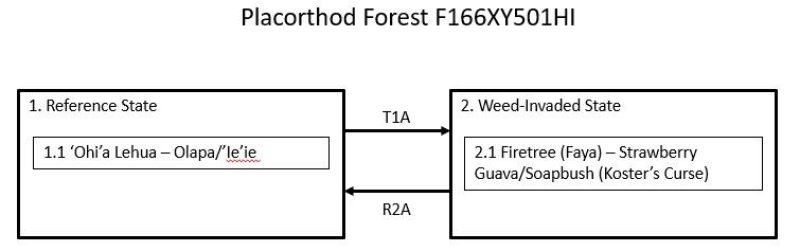


Click on box and path labels to scroll to the respective text.
Ecosystem states
| T1A | - | The Reference State (1) transitions to the Weed-Invaded State (2) by invasion of introduced plant species. Disturbance by feral deer, goats, mouflon sheep, and pigs will hasten this process, as will landslides and hurricanes. |
|---|---|---|
| R2A | - | Restoration of the Weed-Invaded State (2) to the Reference State (1) or a facsimile of it may be possible by installing ungulate-proof fence, removing all ungulates, removing introduced plant species, and replanting native species when needed. Long term weed management and fence maintenance would be necessary. |