Ecological dynamics
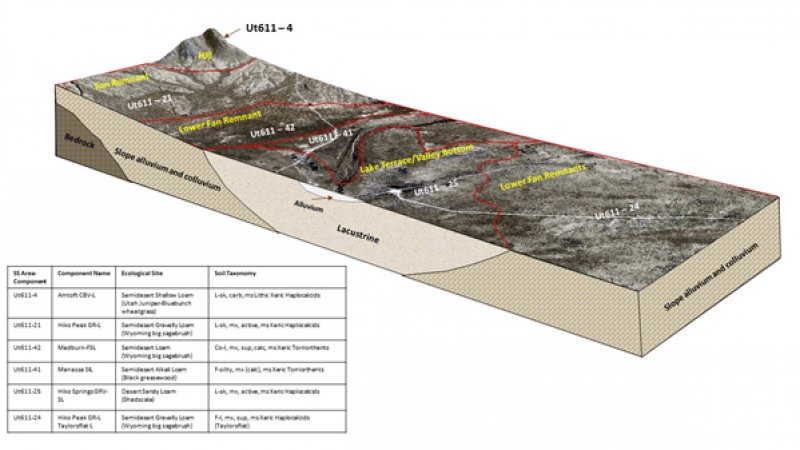
The Semidesert Alkali Loam (Black Greasewood) South site is a broad ecotone between Alkali Flat (Greasewood) 028AY004UT and Semidesert Loam (Wyoming big sagebrush) 028AY220UT that occurs on lake terraces and fan remnants. Greasewood increases as the ecotone nears the Alkali Flat site and Wyoming big sagebrush (Artemisia tridentata ssp. Wyomingensis) increases as it nears Semidesert Loam. There is often an equal mixture of both shrubs in the community.
Black greasewood (Sarcobatus vermiculatus) requires access to groundwater and develops best where moisture is easily available (Eddleman 2002; Mozingo 1987; Brown 1965). It is a deep-rooted shrub and the groundwater can be fairly deep in the soil profile. Wyoming big sagebrush is the most drought tolerant of the big sagebrushes and is generally long-lived. Seedling establishment every year is not necessary to keep the stand intact. Common bunchgrasses in this site are Nevada bluegrass (Poa secunda), bottlebrush squirreltail (Elymus elymoides), Indian ricegrass (Achnatherum hymenoides), and James' galleta (Pleuraphis jamesii). These grasses are tolerant to drier conditions that exist on this site.
These communities often exhibit the formation of microbiotic crusts within the interspaces between shrubs. These crusts influence the soils on these sites and their ability to reduce erosion and increase infiltration; they may also alter the soil structure and possibly increase soil fertility (Fletcher and Martin 1948, Williams 1993). Finer-textured soils such as silts tend to support more microbiotic cover than coarse-textured soils (Anderson 1982). Disturbance such as hoof action from inappropriate grazing and cheatgrass invasion can reduce biotic crust integrity (Anderson 1982, Ponzetti et al. 2007) and increase erosion.
Ecosystem drivers can range from insect outbreaks, to fire, to grazing. Native insects, like the Aroga moth, can defoliate and kill sagebrush (Furniss & Barr 1975). These events have been cyclical and are influenced by climate patterns.
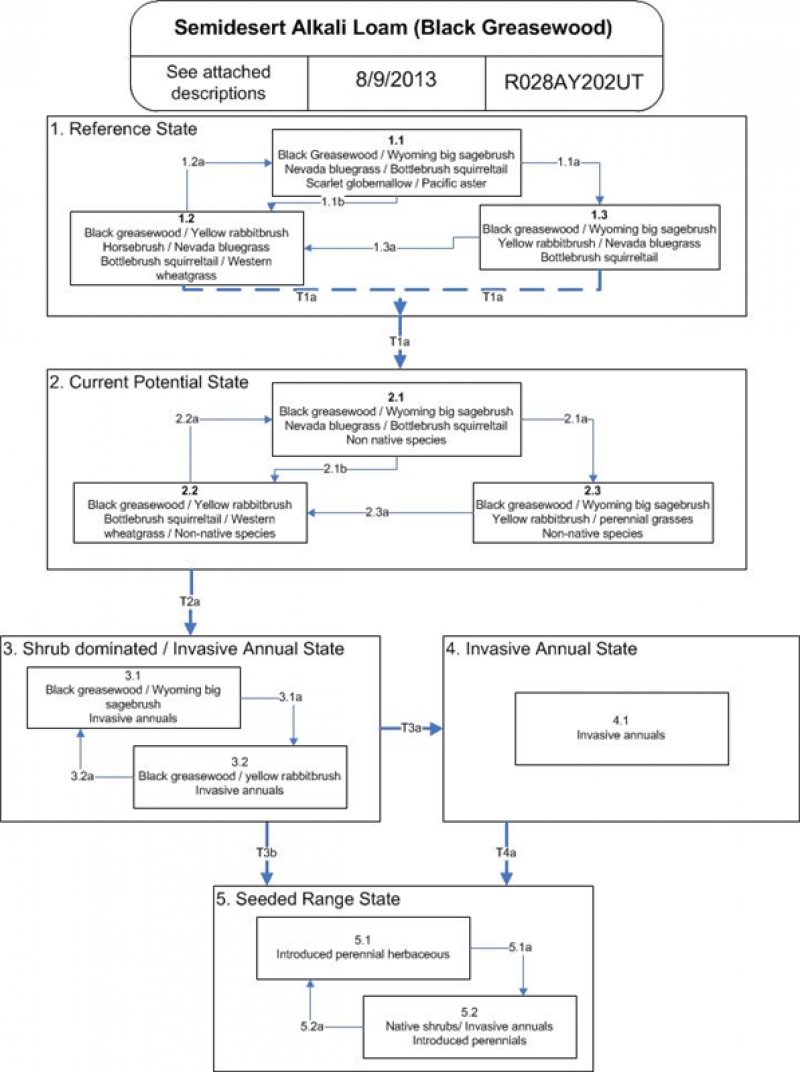
Annual non-native species such as Halogeton (Halogeton glomeratus), Russian thistle (Salsola iberica) , and cheatgrass (Bromus tectorum) invade these sites where competition from perennial species is decreased. This ecological site has low resilience to disturbance and resistance to invasion. Increased resilience increases with elevation, aspect, increased precipitation and increased nutrient availability. Five possible stable states have been identified for this site.
Fire Ecology:
Fire is a rare disturbance in salt-desert shrub communities likely occurring in years with above-average production. Black greasewood may be killed by severe fires, but can resprout after low to moderate severity fires (Robertson 1983, West 1994). Grazing and other disturbance may result in increased biomass production due to sprouting and increased seed production, also leading to greater fuel loads (Sanderson and Stutz 1994). Higher production sites would have experienced fire more frequently than lower production sites.
Wyoming big sagebrush is easily killed by fire (Blaisdell 1953). Wyoming big sagebrush only regenerates from seed. Repeated fires may eliminate the onsite seed source and reestablishment after fire may require 50-120 or more years (Baker 2006). Even then, up to 25 years after fire, Wyoming big sagebrush typically has less than 5 percent of pre-fire cover (Baker 2011). However, the introduction and expansion of cheatgrass has dramatically altered the fire regime (Balch et al. 2013), therefore altering restoration potential of Wyoming big sagebrush communities (Evans and Young 1981). Sites with low abundances of native perennial grasses and forbs typically have reduced resiliency following disturbance and are less resistant to invasion or increases in cheatgrass (Miller et al 2013).
State 1
Reference State
The Reference State is a representative of the natural range of variability under reference conditions. The Reference State has three general community phases; a shrub grass dominant phase, a perennial grass dominant phase and a shrub dominant phase. State dynamics are maintained by interactions between climatic patterns and disturbance regimes. Negative feedbacks enhance ecosystem resilience and contribute to the stability of the state. These include the presence of all structural and functional groups, low fine fuel loads, and retention of organic matter and nutrients. Plant community phase changes are primarily driven by fire, periodic drought and/or insect or disease attack.
Community 1.1
Black greasewood-Wyoming big sagebrush/squirreltail
This community is dominated by Black greasewood and Wyoming big sagebrush in the shrub layer. Bottlebrush squirreltail dominates the herbaceous layer with significant amounts of Nevada bluegrass and Indian ricegrass commonly present. Typical forbs include scarlet globemallow and Pacific aster. Shadscale and yellow rabbitbrush are other important shrubs. Percent composition by air-dry weight is 35 percent grass, 10 percent forbs, and 50 percent shrubs. Natural fire frequency is estimated to be 40 to 50 years.
Table 5. Annual production by plant type
| Plant type |
Low
(lb/acre) |
Representative value
(lb/acre) |
High
(lb/acre) |
| Shrub/Vine |
110 |
316 |
440 |
| Grass/Grasslike |
70 |
201 |
280 |
| Forb |
20 |
58 |
80 |
| Total |
200 |
575 |
800 |
Table 6. Ground cover
| Tree foliar cover |
0%
|
| Shrub/vine/liana foliar cover |
20-40%
|
| Grass/grasslike foliar cover |
10-20%
|
| Forb foliar cover |
5%
|
| Non-vascular plants |
0%
|
| Biological crusts |
0%
|
| Litter |
0%
|
| Surface fragments >0.25" and <=3" |
0%
|
| Surface fragments >3" |
0%
|
| Bedrock |
0%
|
| Water |
0%
|
| Bare ground |
0%
|
Table 7. Canopy structure (% cover)
| Height Above Ground (ft) |
Tree |
Shrub/Vine |
Grass/
Grasslike |
Forb |
| <0.5 |
– |
– |
– |
– |
| >0.5 <= 1 |
– |
– |
– |
0-10% |
| >1 <= 2 |
– |
– |
15-25% |
– |
| >2 <= 4.5 |
– |
35-45% |
– |
– |
| >4.5 <= 13 |
– |
– |
– |
– |
| >13 <= 40 |
– |
– |
– |
– |
| >40 <= 80 |
– |
– |
– |
– |
| >80 <= 120 |
– |
– |
– |
– |
| >120 |
– |
– |
– |
– |
| Jan |
Feb |
Mar |
Apr |
May |
Jun |
Jul |
Aug |
Sep |
Oct |
Nov |
Dec |
| J |
F |
M |
A |
M |
J |
J |
A |
S |
O |
N |
D |
Community 1.2
Black greasewood/yellow rabbitbrush
Wyoming big sagebrush decreases significantly in the community, black greasewood also decreases initially but is a vigorous sprouter with fire. Yellow rabbitbrush and, at times, smooth horsebrush, increase in the community and much of the excess fine fuel accumulation is removed. Bottlebrush squirreltail, Nevada bluegrass, Indian ricegrass and other cool season bunchgrasses flourish, western wheatgrass also increases. Fire tolerant shrubs may persist as dominants in the community for 30 years or longer. Percent composition by air-dry weight is 40 percent grass, 10 percent forbs, and 50 percent shrubs.
Community 1.3
Wyoming sagebrush/Black greasewood
Black greasewood, Wyoming big sagebrush and yellow rabbitbrush increase in percent composition. Shrubs become old and decadent. Bottlebrush squirreltail, Indian ricegrass and Nevada bluegrass begin to lose vigor due to increased shrub competition and are becoming dense with old vegetation. Percent composition by air-dry weight is 30 percent grass, 5 percent forbs, and 65 percent shrubs.
Pathway 1.1b
Community 1.1 to 1.2
Disturbance to remove shrub layer, typically fire.
Pathway 1.1a
Community 1.1 to 1.3
Time since disturbance. Time allows shrubs to establish again in the community.
Pathway 1.2a
Community 1.2 to 1.1
Normal fire frequency of 40 to 50 years returns on the site.
Pathway 1.3a
Community 1.3 to 1.2
Recent fire occurrence.
State 2
Current Potential State
Plant communities in the Current Potential State can include both native and non-native species. This state is irreversibly changed from the Reference State because the non-native species will now remain a permanent part of the community.
Community 2.1
Black greasewood/Wyoming sagebrush/Nevada bluegrass/Bottlebrush squirreltail/non-native species
This community is dominated by Black greasewood and Wyoming big sagebrush in the shrub layer. Shadscale and yellow rabbitbrush are also present. Bottlebrush squirreltail dominates the herbaceous layer with significant amounts of Nevada bluegrass and Indian ricegrass. Typical forbs include scarlet globemallow and Pacific aster. This community is dominated by native species but include non-native species. Percent composition by air-dry weight is 35 percemt grass, 10 percent forbs, and 50 percent shrubs. Natural fire frequency is estimated to be 40 to 50 years.
Community 2.2
Black greasewood/yellow rabbitbrush/ bottlebrush squirreltail/ western wheatgrass/non-native species
Fire tolerant shrubs including black greasewood, yellow rabbitbrush, and horsebrush increase and dominate the shrub layer. Wyoming big sagebrush decreases because it is not a fire tolerant species. Bottlebrush squirreltail, Nevada bluegrass, and other native cool season bunchgrasses are significantly reduced. Western wheatgrass and James' galleta may also decrease. This community is similar to community phase 1.2, except the inclusion of non-native species.
Community 2.3
Black greasewood/Wyoming sagebrush/yellow rabbitbrush/perennial grasses/non-native species
Fire has been excluded from this community past the typical fire frequency. Black greasewood, Wyoming big sagebrush and yellow rabbitbrush dominate the overstory; shadscale may increase if present. Bottlebrush squirreltail, Nevada bluegrass, Indian ricegrass, and other native bunchgrasses are significantly reduced. Western wheatgrass and James' galleta begin to decrease. Bare ground may dominate the interspaces in some communities. This community is similar to 1.3, except the non-native species that are present, but do not dominate the site.
Pathway 2.1b
Community 2.1 to 2.2
Recent fire occurrence.
Pathway 2.1a
Community 2.1 to 2.3
Improper grazing (including season long, overstocking, wrong season, etc.) and/or drought that remove annual and perennial fine fuels from the site, lessening the potential for fire to occur. Fire frequency extends beyond the 40 to 50 year average.
Pathway 2.2a
Community 2.2 to 2.1
Fire frequency returns to within the normal range for the community.
Pathway 2.3a
Community 2.3 to 2.2
Recent fire occurrence.
State 3
Shrub Dominated/Invasive Annual State
Native shrubs dominate with an understory of invasive annuals. Native herbaceous plants have been removed either from poor management and/or change in fire return interval.
Community 3.1
Black greasewood/Wyoming sagebrush/invasive annuals
Black greasewood, Wyoming big sagebrush and yellow rabbitbrush dominate the shrub layer and the community. Rubber rabbitbrush and shadscale may occur in significant numbers. Remaining bottlebrush squirreltail, Nevada bluegrass, and other perennial herbaceous vegetation is mostly found only in protected locations under shrubs. Invasive, non-native grasses and weeds including cheatgrass, annual mustards, and redstem storksbill dominate the understory.
Community 3.2
Black greasewood/yellow rabbitbrush/invasive annuals
Black greasewood, yellow rabbitbrush and, at times, smooth horsebrush dominate the shrub layer. These fire tolerant shrubs persist as dominants in this community with fire periods reoccurring at intervals of 10 to 30 years or less. Broom snakeweed may be an episodic dominant species when conditions are favorable. Bottlebrush squirreltail, Nevada bluegrass, and other native bunchgrasses are significantly reduced or not found; invasive annuals including cheatgrass, annual mustards, and redstem storksbill dominate the understory.
Pathway 3.1a
Community 3.1 to 3.2
Long-term improper grazing (including season long, overstocking, wrong season, etc.) and/or drought that remove annual and perennial fine fuels from the site, lessening the potential for fire to occur.
Pathway 3.2a
Community 3.2 to 3.1
Time since fire
State 4
Invasive Annual State
Invasive non-native annuals dominate. This can occur from a decrease in the fire return interval, with fire occurring more frequently than typical for the site. This increase in the occurrence of fire can make it difficult even for shrubs that sprout like greasewood and rabbitbrush to survive. Frequent fires favor the establishment and dominance of annual species, like cheatgrass. Once annual species are dominant, this increases the likelihood of the site to be burned on a regular basis because of the increase in fine fuels.
Community 4.1
Invasive annuals
Dominance of annual grasses and forbs increases fire frequency interval. More frequent fires again establish annual species decreasing the shrub cover or eliminating shrubs from the site.
State 5
Seeded Range State
The Seeded Range State is seeded to species that may be composed of introduced and native species. Shrubs may or may not be present in this state, but are typically present from natural regeneration. Invasive annual species are also typically present.
Community 5.1
Introduced perennial herbaceous
The Introduced Perennial Herbaceous community phase is seeded to rangeland species that may be composed of introduced, native or combination species. Shrubs are reduced but may occupy a portion of the site because of natural regeneration. Invasive annual grasses and weedy forb species, primarily cheatgrass and various annual mustards, may be present in the seeding.
Community 5.2
Native shrubs/invasive annuals/introduced perennials
Community Phase 5.2 is present after either a failed seeding or a poorly managed one. Site may be herbaceous or may be returning to shrubs. The community phase is primarily composed of black greasewood and other native shrub species, invasive annual grasses and weedy forb species, mostly cheatgrass and various annual mustards are also able to re-invade this site. Broom snakeweed may be an episodic dominant species when conditions are favorable.
Pathway 5.1a
Community 5.1 to 5.2
Seeding is not well established; improper grazing (including season long, overstocking, wrong season, etc.) and/or drought reduce any perennial grasses established. Highly combustible fine fuels from invasive annuals shorten the fire frequency on the site. Fire frequency is typically 10 to 20 years.
Pathway 5.2a
Community 5.2 to 5.1
Site receives excellent grazing management over a long period of time. Highly combustible fine fuels from invasive annuals continue to dominate the community resulting in a shortened fire frequency. Fire frequency is typically 10 to 20 years. Seeded perennial vegetation slowly recovers.
Transition T1a
State 1 to 2
Introduction and establishment of non-native species. This decreases resistance and resilience to disturbance.
Transition T2a
State 2 to 3
Decrease in shrub removal disturbance, like fire. This can increase shrub dominance and decrease herbaceous cover. This is often accompanied by an increase in non-native plant species.
Transition T3a
State 3 to 4
Disturbance that removes shrubs, such as fire. Fire in this state when there is a dominance of annual non-native grass, like cheatgrass, will create a community after the fire that is often dominated by annual non-native species.
Transition T3b
State 3 to 5
Human intervention with the introduction of native or non-native bunchgrasses and forbs.
Transition T4a
State 4 to 5
Human intervention with the introduction of native or non-native bunchgrasses and forbs.