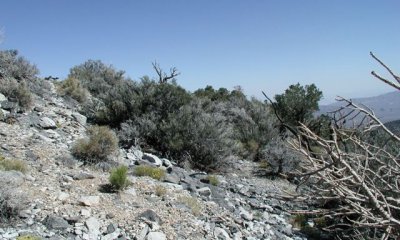
The reference state is representative of the natural range of variability under pristine conditions. Dominant vegetation is littleleaf mountain mahogany with scattered trees. Large scale disturbance is infrequent in this system. Plant community phase changes are primarily driven by small scale disturbances from lightning, low severity fire, insects, wind and snow. These small disturbances create canopy gaps in dense stands of mahogany and gaps allow for the release of immature littleleaf mountain mahogany. Soils supporting stands of mountain mahogany have increased levels of nitrogen. Mountain mahogany has root nodules capable of fixing nitrogen, increasing the levels of total nitrogen thereby influencing plant succession.
Currently this ecological site is described by a one-state model because additional states have not been identified on the landscape. For example, non-native plant species have not been identified on this ecological site. However, non-natives such as cheatgrass are capable of establishing in high elevation plant communities similar to this one. If in the future non-natives are found in this ecological site the state-and-transition model will be revised to include State 2: Invaded State.
Submodel
1.1. Reference Plant Community
1.2. Plant Community 1.2
Model keys
Briefcase
Add ecological sites and Major Land Resource Areas to your briefcase by clicking on the briefcase () icon wherever it occurs. Drag and drop items to reorder. Cookies are used to store briefcase items between browsing sessions. Because of this, the number of items that can be added to your briefcase is limited, and briefcase items added on one device and browser cannot be accessed from another device or browser. Users who do not wish to place cookies on their devices should not use the briefcase tool. Briefcase cookies serve no other purpose than described here and are deleted whenever browsing history is cleared.
The Ecosystem Dynamics Interpretive Tool is an information system framework developed by the USDA-ARS Jornada Experimental Range, USDA Natural Resources Conservation Service, and New Mexico State University.



 ) icon wherever it occurs. Drag and drop items to reorder. Cookies are used to store briefcase items between browsing sessions. Because of this, the number of items that can be added to your briefcase is limited, and briefcase items added on one device and browser cannot be accessed from another device or browser. Users who do not wish to place cookies on their devices should not use the briefcase tool. Briefcase cookies serve no other purpose than described here and are deleted whenever browsing history is cleared.

