Ecological dynamics
Potential vegetation on this site is dominated by mid cool-season perennial grasses. Other significant vegetation includes sagebrushes and a variety of forbs and shrubs. The expected potential composition for this site is about 75% grasses, 10% forbs and 15% woody plants. The composition and production will vary naturally due to historical use, fluctuating precipitation and fire frequency.
As this site deteriorates, species such as threadleaf sedge, blue grama, and big sagebrush will increase. Plains pricklypear and weedy annuals will invade. Cool season grasses such as needleandthread, rhizomatous wheatgrasses, and Indian ricegrass will decrease in frequency and production.
The Historic Climax Plant Community (description follows the plant community diagram) has been determined by study of rangeland relic areas, or areas protected from excessive disturbance. Trends in plant communities going from heavily grazed areas to lightly grazed areas, seasonal use pastures, and historical accounts have also been used.
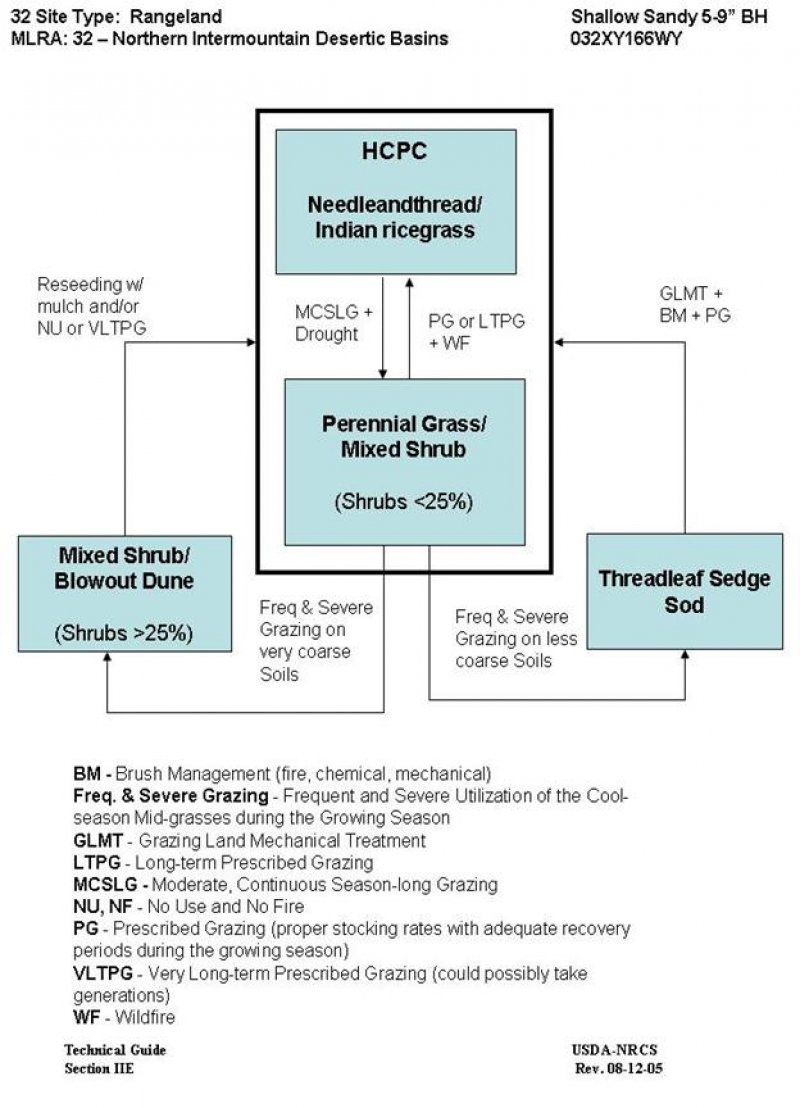
The following is a State and Transition Model Diagram that illustrates the common plant communities (states) that can occur on the site and the transitions between these communities. The ecological processes will be discussed in more detail in the plant community narratives following the diagram.
State 1
Needleandthread/Indian Ricegrass Plant Community
Community 1.1
Needleandthread/Indian Ricegrass Plant Community
The interpretive plant community for this site is the Historic Climax Plant Community. This state evolved with grazing by large herbivores, soils less than 15 inches in depth, and periodic fires. The cyclical nature of the fire regime in this community and the shallow soils prevented big sagebrush from being the dominant landscape. Cool season midgrasses dominate the state. Potential vegetation is about 75% grasses or grass-like plants, 10% forbs, and 15% woody plants. It is found on areas that are properly managed with grazing and/or prescribed burning, and sometimes on areas receiving occasional short periods of rest.
The major grasses include needleandthread, rhizomatous wheatgrasses, Indian ricegrass, and bluebunch wheatgrass. Other grasses occurring on the state include Sandberg bluegrass, and threadleaf sedge. A variety of forbs and shrubs also occur in this state and plant diversity is high (see Plant Composition Table).
The total annual production (air-dry weight) of this state is about 325 pounds per acre, but it can range from about 200 lbs. /acre in unfavorable years to about 400 lbs. /acre in above average years.
The state is stable and well adapted to the Northern Intermountain Desertic Basins climatic conditions. The diversity in plant species allows for high drought resistance. This is a sustainable plant community (site/soil stability, watershed function, and biologic integrity).
Transitions or pathways leading to other plant communities are as follows:
• Moderate, Continuous Season-Long grazing will convert the plant community to the Perennial Grass/Mixed Shrub Plant Community. Prolonged drought will exacerbate this transition.
| Jan |
Feb |
Mar |
Apr |
May |
Jun |
Jul |
Aug |
Sep |
Oct |
Nov |
Dec |
| J |
F |
M |
A |
M |
J |
J |
A |
S |
O |
N |
D |
State 2
Perennial Grass/Mixed Shrub Plant Community
Community 2.1
Perennial Grass/Mixed Shrub Plant Community
Historically, this plant community evolved under grazing and a low fire frequency. Currently, it is found under moderate, season-long grazing by livestock and will be exacerbated by prolonged drought conditions. In addition, the fire regime for this site has been modified and extended periods without fire is now common. This plant community is still dominated by cool-season grasses, while short warm-season grasses and miscellaneous forbs account for the balance of the understory.
The overstory is comprised of a variety of shrubs.
The dominant grasses include needleandthread, rhizomatous wheatgrasses, threadleaf sedge, Sandberg bluegrass, and blue grama. Forbs commonly found on the site include badlands mule’s-ear, waxleaf penstemon, little larkspur, sulfur flower buckwheat, fleabane, and lemon scurfpea. Shrubs can make up to 25% of the annual production. These include big sagebrush, silver sagebrush, shadscale saltbush, and rabbitbrushes. The overstory of shrubs and understory of grass and forbs provide a diverse plant community.
When compared to the Historic Climax Plant Community, bluebunch wheatgrass and Indian ricegrass have decreased. Plains pricklypear cactus may have invaded, but occurs only in small patches. Threadleaf sedge, blue grama, big sagebrush, rabbitbrushes and a variety of forbs have increased. Total production is less as the mid cool season grasses are replaced with short warm season grasses.
The total annual production (air-dry weight) of this state is about 200 pounds per acre, but it can range from about 75 lbs. /acre in unfavorable years to about 300 lbs. /acre in above average years.
The herbaceous component is mostly intact and plant vigor and replacement capabilities are sufficient. Water flow patterns and litter movement may be occurring but only on steeper slopes. Incidence of pedestalling is minimal. Soils are mostly stable and the surface shows minimum soil loss. The communities’ soil, biotic integrity and watershed is intact, although more than normal runoff may occur due to the sod forming vegetation and bare ground.
Transitional pathways leading to other plant communities are as follows:
• Prescribed grazing or possibly long-term prescribed grazing will return this plant community to the HCPC. The probability of this occurring is high especially if rotational grazing along with short deferred grazing is implemented as part of the prescribed method of use. In addition, the removal of fire suppression will allow a somewhat natural fire regime to reoccur to more easily transition between this plant community and the HCPC. A prescribed fire treatment can be useful to hasten this transition if desired; however, this may require a removal of grazing for a period of time to build a surplus of fine fuels.
• Frequent and Severe grazing on very coarse soils will convert this state to the Mixed Shrub/Blowout Dune Plant Community.
• Frequent and Severe grazing on less coarse soils will convert this state to the Threadleaf Sedge Sod Plant Community.
| Jan |
Feb |
Mar |
Apr |
May |
Jun |
Jul |
Aug |
Sep |
Oct |
Nov |
Dec |
| J |
F |
M |
A |
M |
J |
J |
A |
S |
O |
N |
D |
State 3
Mixed Shrub/Blowout Dune Plant Community
Community 3.1
Mixed Shrub/Blowout Dune Plant Community
This plant community is the result of frequent and severe grazing and protection from fire. Shrubs eventually dominate this vegetative state as the annual production of shrubs will exceed 25%. Areas of bare sand also can dominate this site as wind scouring and deposition can occur and modify the soil surface. Yucca on coarser soils can also be a major part of this plant community. These shrub species are a significant component of the plant community and the preferred cool season grasses have been eliminated or greatly reduced.
The dominant grasses are Sandberg bluegrass, threadleaf sedge, and blue grama. Weedy annual species such as cheatgrass may occupy the site if a seed source is available. Patches of pricklypear cactus can be noticeable. Shrubs such as big and silver sagebrushes, rabbitbrushes, and a variety of forbs have increased significantly. Plant diversity is moderate to poor. The interspaces between plants have expanded leaving the amount of bare ground more prevalent. When compared to the HCPC, grass production and available forage has diminished significantly, but the total production is compensated by the increase in shrub production.
The total annual production (air-dry weight) of this state is about 125 pounds per acre, but it can range from about 50 lbs. /acre in unfavorable years to about 200 lbs. /acre in above average years.
This plant community is relatively resistant to change. Continued frequent and severe grazing does not seem to affect the plant composition or structure of the plant community. These areas are more resistant to fire as less fine fuels are available and the bare ground between the shrub plants is increased. Plant diversity is poor. Production is reduced and plant vigor is diminished due to blowing sand, which can defoliate the vegetative parts of the grass plants.
The soils are exposed to wind as erosion is accelerated and blowouts increase. Pedestalling is pervasive and eolian deposits (dunes) form around the clumped vegetation. This situation is normally extensive.
Transitions or pathways leading to other plant communities are as follows:
• Reseeding with mulch and/or no use or very long-term prescribed grazing, is necessary to return a protective vegetation cover to this state so as to convert this to the Near HCPC conditions. No use may return protective vegetation cover to the site or possible prescribed grazing that may take generations, may also accomplish this goal. The grazing prescription most commonly used is complete deferment during the growing season, with limited use in the winter. This will provide as much plant litter cover as possible to protect the soil surface.
| Jan |
Feb |
Mar |
Apr |
May |
Jun |
Jul |
Aug |
Sep |
Oct |
Nov |
Dec |
| J |
F |
M |
A |
M |
J |
J |
A |
S |
O |
N |
D |
State 4
Threadleaf Sedge Sod Plant Community
Community 4.1
Threadleaf Sedge Sod Plant Community
This plant community can occur as a result of frequent and severe grazing on less coarse soils.
Rabbitbrushes, and possibly yucca may remain significant components of the plant community, but a dense stand of threadleaf sedge is established. Pricklypear cactus can also become established in dense patches.
Grasses of importance are needleandthread, Sandberg bluegrass and blue grama. Patches of annuals such as cheatgrass and other weedy annual forbs such as halogeton, Russian thistle, and kochia, will persist on this site, if not treated. The interspaces between plants will have diminished in size.
When compared with the HCPC or the Perennial Grass/Mixed Shrub Plant Communities, the annual production is less. Some of the climax grasses, such as Indian ricegrass, may not be present.
The total annual production (air-dry weight) of this state is about 150 pounds per acre, but it can range from about 50 lbs. /acre in unfavorable years to about 250 lbs. /acre in above average years.
This sod is some what resistant to change under moderate grazing and the reestablishment of perennial mid and tall grasses is difficult in this situation. The biotic integrity of this state is minimally functional and plant diversity is moderate to low.
Erosion has been diminished as the sodded areas are resistant to wind erosive processes. Pedestalling is apparent along the sod edges.
Transitional pathways leading to other plant communities are as follows:
• Grazing land mechanical treatment (seeding, etc.), brush management if necessary, and continued prescribed grazing, will return this plant community to near Historic Climax Plant Community. Any chiseling or disturbance in the sod should be implemented carefully so as not to create large openings, which can expose the soil to wind erosion.
| Jan |
Feb |
Mar |
Apr |
May |
Jun |
Jul |
Aug |
Sep |
Oct |
Nov |
Dec |
| J |
F |
M |
A |
M |
J |
J |
A |
S |
O |
N |
D |