

Calcareous Limestone Exposed Backslope Woodland

Scenario model
Current ecosystem state
Select a state
Management practices/drivers
Select a transition or restoration pathway
- Transition T1A More details
- Transition T1B More details
- Restoration pathway R2A More details
- Transition T2B More details
- Transition T2A More details
- Transition T3A More details
- Transition T4A More details
-
No transition or restoration pathway between the selected states has been described
Target ecosystem state
Select a state
Description
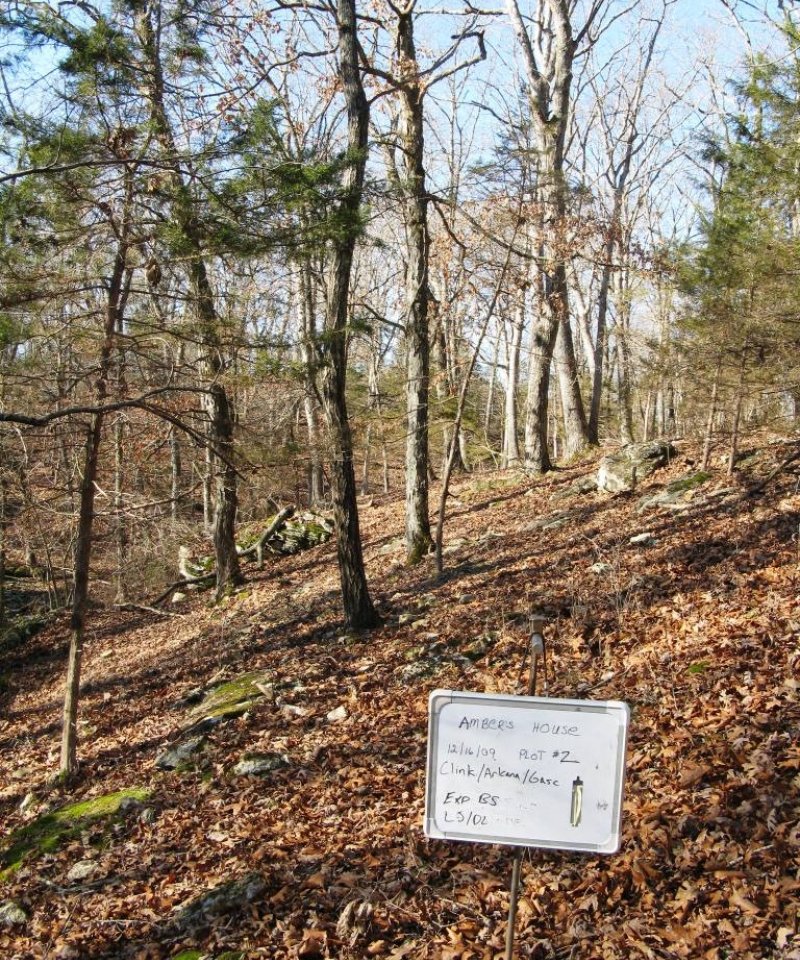
The reference state was dominated by chinkapin oak and ash. Maximum tree age was likely 150 to 300 years. Periodic disturbances from fire, wind or ice maintained the dominance of white and chinkapin oak by opening up the canopy and allowing more light for oak reproduction. Long disturbance-free periods allowed an increase in more shade tolerant species such as northern red oak and sugar maple. Two community phases are recognized in this state, with shifts between phases based on disturbance frequency.
Submodel
Description
Lower disturbance levels has allowed these woodlands to become dense with saplings such as ash and hickory. The dense, shaded conditions and lack of disturbance has caused the ground flora to decrease in cover and diversity. However, many of the original herbaceous species can persist as small plantlets or in the seed bank.
Submodel
Description
Many of these sites have been subjected to heavy grazing by domestic livestock and periodic logging. These areas are more open with a diminished ground flora. In addition, grazed areas exhibit a lower diversity of native ground flora species and an increase of invasive natives such as coralberry and greenbrier.
Submodel
Description
Conversion of other states to non-native cool season species such as tall fescue and red clover has been common. Occasionally, these pastures will have scattered oaks. Long term uncontrolled grazing can cause significant soil erosion and compaction.
Submodel
Mechanism
This is a gradual transition that results from extended, disturbance free periods of roughly 20 years or longer. Selective logging may also be occurring.
Mechanism
This transition is the result of high-grade logging, uncontrolled domestic livestock grazing and fire suppression.
Mechanism
This restoration pathway is the result of the systematic application of prescribed fire and long term succession. Mechanical thinning may also be used along with understory removal and forest stand improvement.
Mechanism
This transition is the result of high-grade logging and uncontrolled domestic livestock grazing.
Mechanism
This transition is the result of clearing and conversion to non-native cool season grassland.
Mechanism
This transition is the result of livestock exclusion and forest stand improvement.
Model keys
Briefcase
Add ecological sites and Major Land Resource Areas to your briefcase by clicking on the briefcase ( ) icon wherever it occurs. Drag and drop items to reorder. Cookies are used to store briefcase items between browsing sessions. Because of this, the number of items that can be added to your briefcase is limited, and briefcase items added on one device and browser cannot be accessed from another device or browser. Users who do not wish to place cookies on their devices should not use the briefcase tool. Briefcase cookies serve no other purpose than described here and are deleted whenever browsing history is cleared.
Ecological sites
Major Land Resource Areas


The Ecosystem Dynamics Interpretive Tool is an information system framework developed by the USDA-ARS Jornada Experimental Range, USDA Natural Resources Conservation Service, and New Mexico State University.