

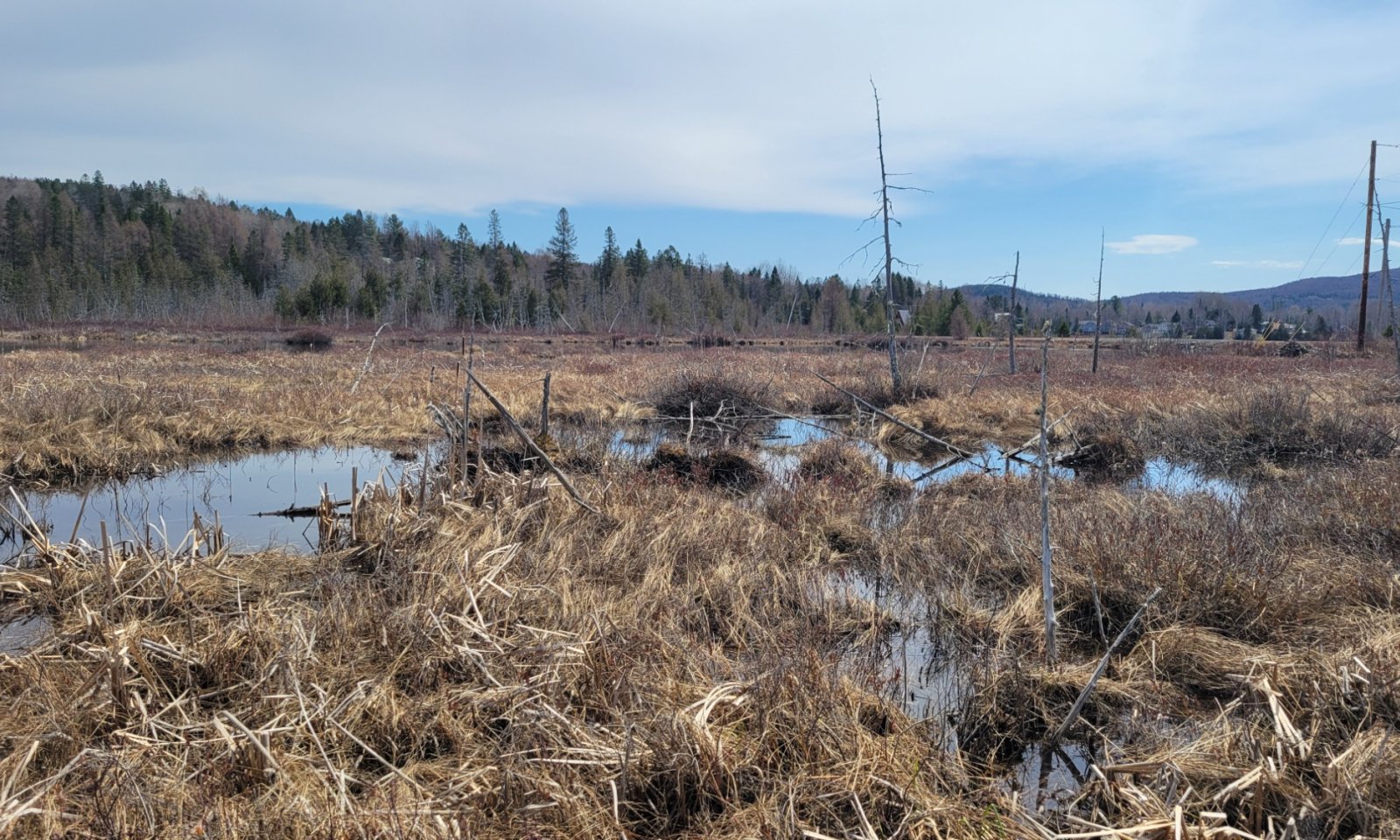
Marsh Wetland Complex

Scenario model
Current ecosystem state
Select a state
Management practices/drivers
Select a transition or restoration pathway
-
Transition T1A
Decreases in local long-term hydroperiods, allowing for the establishment and dominance (>50% cover) of shrubs.
More details -
Transition T1B
Increases in local long-term hydroperiods, creating deeper longer inundation periods and allowing for the establishment and dominance of freshwater emergent species and other deep-water associates OR permanent inundation.
More details -
Transition T1C
Introduction of non-native or exotic species to the system. Establishment and dominance of species (>50% cover) overwhelms native vegetation composition and structure, creating a mixed stand to monoculture.
More details -
Transition T2A
Removal of shrubs (mechanical, biological, or chemical), Increase in local long-term hydroperiods, allowing for the establishment and dominance (>50% cover) of graminoids.
More details -
Transition T2B
Increases in local long-term hydroperiods, creating deeper longer inundation periods and allowing for the establishment and dominance of freshwater emergent species and other deep-water associates OR permanent inundation.
More details -
Transition T2C
Introduction of non-native or exotic species to the system. Establishment and dominance of species (>50% cover) overwhelms native vegetation composition and structure, creating a mixed stand to monoculture.
More details -
Transition T3A
Decreases in local long-term hydroperiods, creating shallower and more temporary inundation periods, allowing for the establishment and dominance (>50% cover) of graminoids.
More details -
Transition T3B
Introduction of non-native or exotic species to the system. Establishment and dominance of species (>50% cover) overwhelms native vegetation composition and structure, creating a mixed stand to monoculture.
More details -
Restoration pathway R4A
Removal of non-native species using manual, chemical, and / or biological methods. Reintroduction of native species dependent on duration or inundation and readily available seedbank.
More details -
Restoration pathway R4B
Removal of non-native species using manual, chemical, and / or biological methods. Reintroduction of native species dependent on duration or inundation and readily available seedbank.
More details -
Restoration pathway R4C
Removal of non-native species using manual, chemical, and / or biological methods. Reintroduction of native species dependent on duration or inundation and readily available seedbank.
More details -
No transition or restoration pathway between the selected states has been described
Target ecosystem state
Select a state
Description
These are graminoid dominant wetlands comprised most often of sedges and grasses in a monotypic or mixed stand of often greater than 50 percent cover. Forbs will often be present in lower amounts and locally abundant but not dominant. Trees, shrubs, and other woody species will often be sparse to absent, occurring as stunted individuals found on microhighs created from past tip ups. The ground cover typically consists of herbaceous litter mixed with bryophytes, which is usually sparse but may occasionally reach over 50 percent cover. The vegetation is often firmly rooted in the substrate and will not form floating mats when inundated unlike similar Sphagnum bog sites. Standing water may be present ranging from only the beginning, or throughout much of the growing season, depending on the site and the years precipitation, with the soil remaining saturated even when water levels drop. Changes in community phases will often be dependent on slight changes in hydroperiod and the presence or absence of a viable seedbank. Further study is needed to assess the potential drivers between community phases and will be left blank until it can be assessed. The absence of community pathway arrows does not indicate these communities can transition to one another and will only exist as standalone stable communities but rather is left blank until data becomes available explaining such a transition.
These community types correlate with LandFire’s CES201.582 “Laurentian-Acadian Wet Meadow-Shrub Swamp” classifications.
Submodel
Description
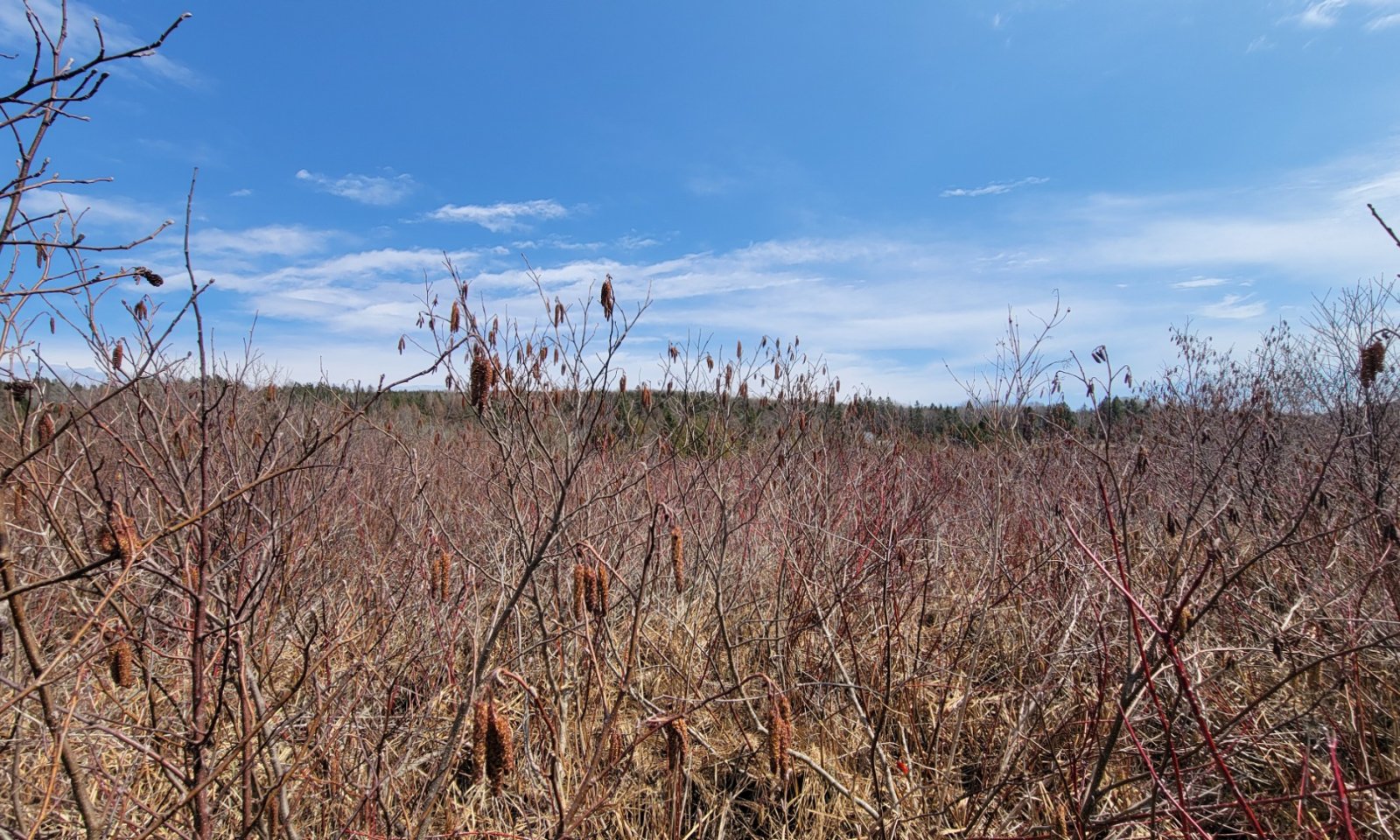
These are wetlands of shrub dominance, often reflecting slightly lower seasonal high-water tables or decreased long-term hydroperiods. In naturally occurring areas shrubs will tend to dominant the higher perimeter and mounds within the graminoid marsh site. These shrubs will often be tall in stature (6 to 26 feet [2 to 8 meters]) and may be moderately open to dense in canopy cover (at least 50 percent cover). Scattered trees may be present, with graminoids and forbs representing the surrounding marsh community locally abundant in canopy openings. A groundcover of mosses is typically present. In areas where shrub swamps are part of a successional pathway for a wooded wetland, the dense canopy cover may delay succession to forested conditions and perpetuate shrubland conditions.
These community types correlate with LandFire’s CES201.582 “Laurentian-Acadian Wet Meadow-Shrub Swamp” classifications.
Submodel
Description
These are wetlands of emergent vegetation and areas of open water, often reflecting slightly higher seasonal high-water tables or increased long-term hydroperiods. Hydrologic regimes are often the longest in this state, with long-term or permanent inundation influencing the development of freshwater emergent species. Organic soils are often deepest in these states but may often include shallow organics or high organic content mineral soils. These communities will often form near monocultures and be so dense that germination of other species is limited.
These community types correlate with LandFire’s CES201.594 “Laurentian-Acadian Freshwater Marsh” classifications.
Submodel
Description
These are wetlands in which non-native or exotic invasive species have been locally introduced and occur as a monoculture or as a mixed association with other native species but comprising more than 50 percent cover.
Submodel
Mechanism
This can occur through decreases in the long-term hydroperiod, causing the seasonal high water table to lower and allow the establishment of shrub dominance. This may occur naturally through beaver dam removal or anthropogenically through landscape level drainage or anthropogenic dam removal.
Mechanism
This can occur through increases in the long-term hydroperiod, causing the seasonal high water table to increase, potentially causing permanent inundation, and allow the establishment of non-persistent freshwater emergents. This may occur naturally through beaver dam creation or anthropogenically through anthropogenic dam installation.
Mechanism
This may occur through changes in the long-term hydroperiod as well as changes in nutrient loads to the system. This is often a result of anthropogenic disturbance.
Mechanism
This can occur through increases in the long-term hydroperiod, causing the seasonal high water table to increase, killing the existing shrubs, and allow the establishment of graminoid. This may occur naturally through beaver dam creation or anthropogenically through anthropogenic dam installation. Mechanical, biological, or chemical removal of shrubs may occur as well.
Mechanism
This can occur through increases in the long-term hydroperiod, causing the seasonal high water table to increase, killing the existing shrubs, and allow the establishment of freshwater non-persistent emergents. This may occur naturally through beaver dam creation or anthropogenically through anthropogenic dam installation.
Mechanism
This may occur through changes in the long-term hydroperiod as well as changes in nutrient loads to the system. This is often a result of anthropogenic disturbance.
Mechanism
This can occur through decreases in the long-term hydroperiod, causing the seasonal high water table to low, removing the hydroperiod needed for freshwater emergent dominance, and allow the establishment of graminoids. This may occur naturally through beaver dam removal or anthropogenically through landscape level drainage or anthropogenic dam removal. Seeding of native graminoids may be needed, depending on the duration of the sites permanent inundation (i.e. a depleted seedbank).
Mechanism
This may occur through changes in the long-term hydroperiod as well as changes in nutrient loads to the system. This is often a result of anthropogenic disturbance.
Mechanism
This may occur through the use of chemical, biological, or mechanic treatments that removes non-native and exotic species, allowing for the reestablishment of native grasses, forbs, and shrubs. Restoration may require extensive time and money, and there is no guarantee it may work. Coordination with your local NRCS office to manage noxious and exotic species is recommended.
Mechanism
This may occur through the use of chemical, biological, or mechanic treatments that removes non-native and exotic species, allowing for the reestablishment of native grasses, forbs, and shrubs. Restoration may require extensive time and money, and there is no guarantee it may work. Coordination with your local NRCS office to manage noxious and exotic species is recommended.
Mechanism
This may occur through the use of chemical, biological, or mechanic treatments that removes non-native and exotic species, allowing for the reestablishment of native grasses, forbs, and shrubs. Restoration may require extensive time and money, and there is no guarantee it may work. Coordination with your local NRCS office to manage noxious and exotic species is recommended.
Model keys
Briefcase
Add ecological sites and Major Land Resource Areas to your briefcase by clicking on the briefcase ( ) icon wherever it occurs. Drag and drop items to reorder. Cookies are used to store briefcase items between browsing sessions. Because of this, the number of items that can be added to your briefcase is limited, and briefcase items added on one device and browser cannot be accessed from another device or browser. Users who do not wish to place cookies on their devices should not use the briefcase tool. Briefcase cookies serve no other purpose than described here and are deleted whenever browsing history is cleared.
Ecological sites
Major Land Resource Areas


The Ecosystem Dynamics Interpretive Tool is an information system framework developed by the USDA-ARS Jornada Experimental Range, USDA Natural Resources Conservation Service, and New Mexico State University.