



Natural Resources
Conservation Service
Ecological site VX157X01X008
Rocky Isothermic Naturalized Grassland Koa haole/guineagrass - buffelgrass/glycine (Leucaena leucocephala/Urochloa maxima - Cenchrus ciliaris/Neonotonia wightii)
Last updated: 5/08/2025
Accessed: 02/15/2026
General information
Provisional. A provisional ecological site description has undergone quality control and quality assurance review. It contains a working state and transition model and enough information to identify the ecological site.
MLRA notes
Major Land Resource Area (MLRA): 157X–Arid and Semiarid Low Mountain Slopes
This MLRA occurs in the State of Hawaii on the islands of Hawaii and Maui. It consists primarily of moderately dissected, gently sloping to steep, leeward mountain slopes. Elevation ranges from sea level to about 6000 feet (0 to 1830 meters). Underlying geology is largely basaltic aa, which is covered by volcanic ash. Climate is dry tropical. Average annual precipitation typically ranges from 10 to 35 inches (255 to 890 millimeters), rising to 45 inches (1145 millimeters) on higher slopes, and mostly occurs from October through May. Much of the rainfall occurs in kona storms during winter. Average annual temperatures range from 55 to 76 degrees F (13 to 24 degrees C), with very little seasonal variation. Soils are mostly Andisols, Mollisols, and Aridisols with isohyperthermic or isothermic soil temperature regimes and ustic or aridic soil moisture regimes. Native vegetation is now rare and consists of species characteristic of dry habitats, such as ilima, wiliwili, and aiea. Common naturalized plant species include grasses such as buffelgrass and kikuyugrass and trees such as kiawe are common.
Classification relationships
This ecological site occurs within Major Land Resource Area (MLRA) 157 - Arid and Semiarid Low Mountain Slopes.
Ecological site concept
This ecological site is naturalized grassland, with some remnant native vegetation, on the western and southern slopes of Haleakala on the island of Maui. Most of the area is owned by the State of Hawaii and Division of Hawaiian Homelands, but parts are on large, private ranches and other private holdings. Examples of this ecological site can be seen from Route 31/37 Piilani Highway.
The central concept of the Rocky Isothermic Naturalized Grassland is of well drained, deep Andisols or shallow Mollisols formed in deposits of volcanic ash deposited over aa lava flows. Annual air temperatures and rainfall are associated with warm (isothermic), seasonally dry (ustic) soil conditions. High rock contents (very stony, extremely stony) in the soils reduce their plant available water holding capacity in usually coarse-textured surface horizons but, by reducing soil content per unit volume, allow water to infiltrate deep into the soil for storage in finer-textured subsurface horizons. Elevations range from about 1000 feet (310 meters) to 2600 feet (800 meters); extreme elevations range as low as 400 feet (125 meters) to as high as 3500 feet (1077 meters) where parts of this ecological site transition to other ecological sites. Because very little of the original native vegetation remains, the reference state of this ecological site consists of naturalized grassland vegetation. The dominant grass species is guineagrass (Urochloa maxima), although buffelgrass (Pennisetum ciliare) commonly occurs at the lower elevations of the ecological site.
Associated sites
| VX157X01X003 |
Rocky Volcanic Ash Savanna Kiawe/buffelgrass (Prosopis pallida/Pennisetum ciliare) The Rocky Volcanic Ash Savanna is on the islands of Hawaii and Maui. It has a warmer soil temperature regime (isohyperthermic), drier soil moisture regime (mostly ustic), lower average annual rainfall (7 to 20 versus 20 to 40 inches), lower elevation range (0 to about 2200 versus 1000 to 2600 feet), supports native savanna rather than dry forest, and has a different dominant forage grass species (buffelgrass versus guineagrass) compared to the Rocky Isothermic Naturalized Grassland. The soils in the Rocky Volcanic Ash Savanna are primarily Aridisols and Andisols compared to Andisols and Mollisols in the Rocky Isothermic Naturalized Grassland. |
|---|---|
| VX158X01X002 |
Isohyperthermic Torric Naturalized Grassland Kiawe/buffelgrass (Prosopis pallida/Pennisetum ciliare) The Isohyperthermic Torric Naturalized Grassland is on the islands of Maui, Molokai, Lanai, and Kauai. It has a warmer soil temperature regime (isohyperthermic versus isothermic), drier soil moisture regime (torric versus ustic), lesser average annual rainfall (10 to 40 versus 20 to 40 inches), a lower elevation range (0 to 1800 versus 1000 to 2600 feet), and a different dominant forage grass species (buffelgrass versus guineagrass) compared to the Rocky Isothermic Naturalized Grassland. The soils in the Isohyperthermic Torric Naturalized Grassland are older and more weathered (mostly Mollisols and Oxisols) than the Andisols and Mollisols in the Rocky Isothermic Naturalized Grassland. |
| VX158X01X004 |
Rocky Isohyperthermic Torric Naturalized Grassland Kiawe/uhaloa/buffelgrass (Prosopis pallida/Waltheria indica/Pennisetum ciliare) The Rocky Isohyperthermic Torric Naturalized Grassland occurs on Maui, Molokai, and Kauai. It adjoins parts of the low elevation boundary of the Rocky Isothermic Naturalized Grassland on Maui. The Rocky Isohyperthermic Naturalized Grassland has a warmer soil temperature regime (isohyperthermic versus isothermic), a drier soil moisture regime (torric versus ustic), lesser average annual rainfall (10 to 20 versus 20 to 40 inches), lower elevation range (0 to 1800 versus 1000 to 2600 feet), supports native savanna and shrubland rather than dry forest, and has a different dominant forage grass species (buffelgrass versus guineagrass) compared to the Rocky Isothermic Naturalized Grassland. Due to older substrates, soils in the Rocky Isohyperthermic Torric Naturalized Grassland are mostly Mollisols rather than the Andisols, Mollisols, or Histosols occuring in the Rocky Isothermic Naturalized Grassland. |
| VX160X01X007 |
Isothermic Ustic Naturalized Grassland (Kikuyugrass) The Isothermic Ustic Naturalized Grassland occurs only on Maui. It adjoins the high elevation boundary of the Rocky Isothermic Naturalized Grassland. The Isothermic Ustic Naturalized Grassland has the same soil temperature regime (isothermic), same soil moisture regime (ustic), greater average annual rainfall (20 to 55 versus 20 to 40 inches), similar elevation range, similar but more diverse native dry forest, and a different dominant forage grass species (kikuyugrass versus guineagrass) compared to the Rocky Isothermic Naturalized Grassland. Soils are nearly all Andisols rather than Andisols, Mollisols, and Histosols occuring in the Rocky Isothermic Naturalized Grassland. |
Similar sites
| VX166X01X002 |
Isothermic Ustic Naturalized Grassland The Isothermic Ustic Naturalized Grassland occurs on Molokai and Lanai. It has the same soil temperature regime (isothermic), same soil moisture regime (ustic), similar average annual rainfall, similar elevation range, similar native dry forest, and same dominant forage grass species compared to the Rocky Isothermic Naturalized Grassland. Soils in the Isothermic Ustic Naturalized Grassland are all nonrocky Mollisols rather than the rocky Andisols, Mollisols, and Histosols occurring in the Rocky Isothermic Naturalized Grassland. |
|---|---|
| VX165X01X001 |
Isothermic Ustic Naturalized Grassland The Naturalized Grassland 30 to 60 Inch Precipitation Zone occurs on West Maui, Molokai, Lanai, Oahu, and Kauai. It has the same soil temperature regime (isothermic), same soil moisture regime (ustic), greater average annual rainfall (30 to 60 versus 20 to 40 inches), higher elevation range (500 to 3400 feet versus 1000 to 2600 feet), similar but more diverse native dry forest, and a different dominant forage grass species (kikuyugrass versus guineagrass) compared to the Rocky Isothermic Naturalized Grassland. Most of the soils are older and more weathered (mostly Ultisols and Oxisols) rather than the Andisols, Mollisols, and Histosols occuring in the Rocky Isothermic Naturalized Grassland. |
Table 1. Dominant plant species
| Tree |
(1) Leucaena leucocephala |
|---|---|
| Shrub |
Not specified |
| Herbaceous |
(1) Urochloa maxima |
Legacy ID
R157XY008HI

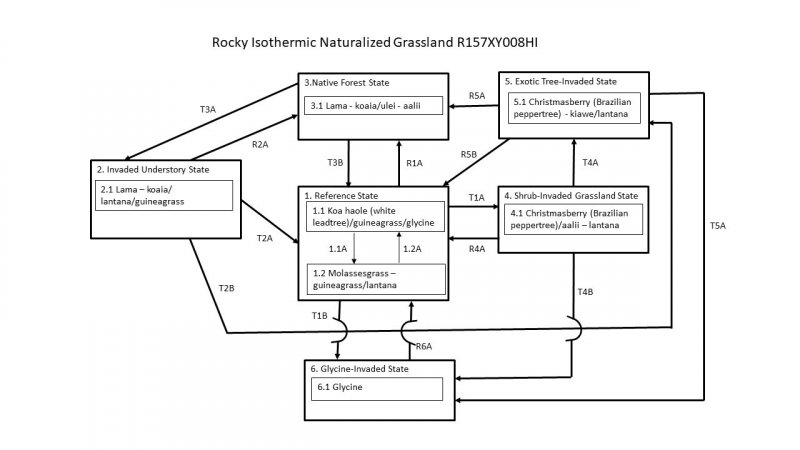

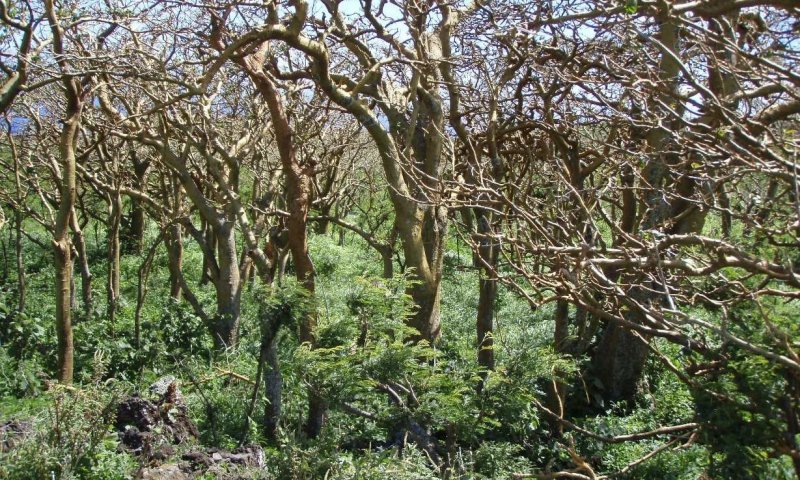
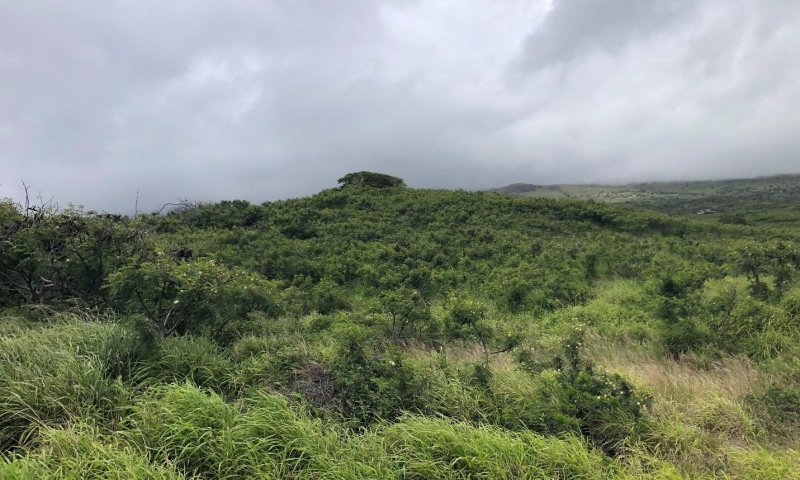
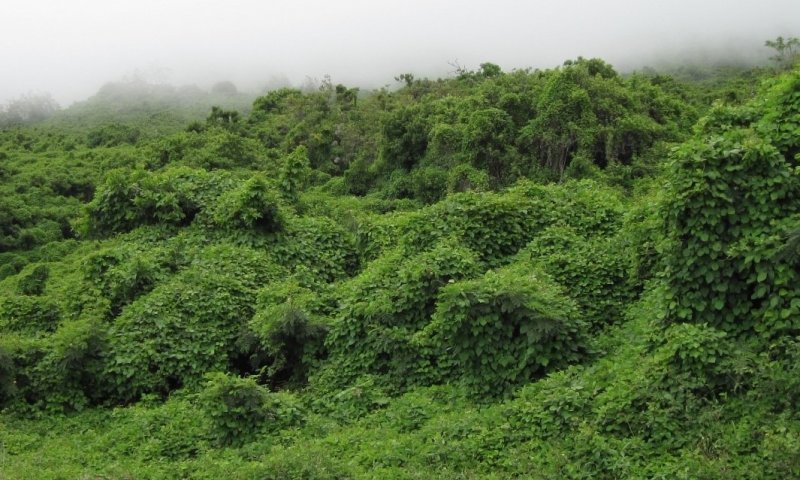


Click on box and path labels to scroll to the respective text.
Ecosystem states
States 1, 5 and 6 (additional transitions)
States 2 and 5 (additional transitions)
| R1A | - | State 1 Reference can be restored to a plant community resembling State 3 Native Forest. Invasive plant species control would be applied to forage species and the many opportunistic plant species that would invade the site. Invasive plant species control would be a perpetual process to maintain the site. Firebreaks must be established and maintained, and suitable fencing must be erected and maintained to exclude domestic and feral ungulates. Extensive planting of native species would follow. |
|---|---|---|
| T1A | - | State 1 Reference transitions to State 4 Shrub-Invaded Grassland in the absence of disturbance such as fire or herbivory by ungulates such that gradual invasion of weedy shrubs and small trees will occur. If the site contained abundant koa haole before abandonment, these small trees will overtop the guineagrass and greatly increase in abundance. To avoid this transition apply a planned grazing system/prescribed grazing and brush control. |
| T1B | - | State 1 Reference will transition to State 6 Glycine-Invaded if ungulate herbivory is absent or too light to control glycine growth. To avoid this transition apply a grazing management plan/prescribed grazing and/or herbaceous weed control measures.. |
| T2A | - | State 2 Invaded-Understory transitions to State 1 Reference when the native overstory is cleared by disturbance such as fire or by mechanical means. Once cleared it is likely that weed species released from the soil seed bank will require invasive plant species control measures. Seed or plant desired perennial grasses as needed. |
| R2A | - | State 2 Invaded-Understory may be restored to a facsimile of State 3 Native Forest by removal of the introduced understory through application of Invasive plant species control and brush control measures. Reintroduction of native understory species is required. The site must be fenced securely to exclude ungulates, and a firebreak must be established and maintained. |
| T2B | - | State 2 Invaded-Understory transitions to State 5 Exotic Tree-Invaded by growth of introduced tree species through and above the native canopy, resulting in competition for light, nutrients and space. Lack of reproduction, establishment and persistence leads to gradual loss of most native tree species. This transition may be avoided by applying Invasive plant species management measures. |
| T3B | - | State 3 Native Forest transitions to State 1 Reference when native vegetation is cleared by disturbances such as fire or by mechanical means. Once cleared, seed or plant desirable perennial grass and forb species and apply invasive plant species management as needed. |
| T3B | - | State 3 Native Forest transitions to State 2 Invaded-Understory through grazing, browsing, rooting, and trampling by domestic or feral ungulates (cows, sheep, deer, goats, and pigs). These activities destroy small native plant species and seedlings and saplings of large species. Regeneration of the native forest is prevented, leading to tree populations consisting almost entirely of mature plants. Lack of competition from native plants, introduction of weed seeds, and disturbance of the soil lead to an understory dominated by introduced plant species. Weeds can invade intact native forest even in the absence of ungulates and gradually bring about the transition. Invasive vines, shrubs, and small trees will grow under intact native canopies and begin to degrade the forest. Eventually, the fine fuels produced by introduced grasses can carry wildfires that destroy the native tree canopy. This transition may be avoided by building a fence to exclude domestic and feral ungulates and by applying continued invasive plant species management measures. |
| T4A | - | State 4 Shrub-Invaded Grassland transitions to State 5 Exotic Tree-Invaded without disturbance such as fire or brush control. Fast-growing introduced tree species invade Shrub Invaded Grassland and quickly overtop shrubs. This transition can be avoided through application of brush management and invasive plant species control measures. |
| R5A | - | State 5 Exotic Tree-Invaded may be restored to State 1 Reference with disturbance such as fire or land clearing by mechanical means. Soil disturbance by heavy machinery may induce germination of the weed seed bank and increase the potential for soil erosion. Invasive plant species control and brush management must then be applied multiple times to control new weed germination and resprouting. After clearing and invasive plant species management, the site would be planted to forage species. Ungulates would have to be excluded until forages are well established; prescribed grazing must then be applied. |
| T5A | - | State 5 Exotic Tree-Invaded transitions to State 6 Glycine-Invaded where glycine (Neonotonia wightii) is present or on adjoining land and is not controlled, or ungulates are not present to consume glycine. This transition can be avoided by application of a planned grazing system/prescribed grazing and/or herbaceous weed control measures. |
| R6A | - | State 6 Glycine-Invaded transitions to State 1 Reference with application of targeted herbivory by livestock or herbaceous weed control. Once glycine has been effectively controlled, desired grasses can be reintroduced as needed during periods when animals are on other paddocks. Transitions T4B and T5A to State 6 Glycine-Invaded has been used intentionally and successfully to smother weedy vegetation up to the size of christmasberry on Kapapala Ranch on the island of Hawaii (Gordon Cran, personal communication). The weedy site is fenced and ungulates are removed, allowing glycine to smother weeds completely. Goats are then allowed onto the site to consume remaining or opportunistic understory weeds; glycine stems become too woody for the goats to eat. After about eight years, the dead trees collapse to the ground. At this point, grazing animals are allowed back on the site to consume glycine. Desired forage grasses can be replanted during periods when animals are on other paddocks. |
State 1 submodel, plant communities
| P1.1A | - | Community phase 1.1 converts to phase 1.2 by fire that reduces competitiveness of guineagrass and allows invasion of weeds, particularly undesirable grasses. Continuous herbivory by domestic or feral ungulates without adequate rest for preferred forages will have the same result. This conversion by either factor can be avoided if timely application of deferred and/or prescribed grazing or removal or exclusion of feral ungulates is carried out to regulate guineagrass stature and to allow recovery of desirable species before weeds become dominant. |
|---|---|---|
| P1.2A | - | Community phase 1.2 can be converted to phase 1.1 by removing undesirable species and favoring and/or reestablishing desirable pasture species. If adequate stands of guineagrass remain, prescribed grazing may eventually bring about the conversion. Pitted beardgrass and Natal red top have some value as forage. However, barbwire grass, Colombian bluestem, and broomsedge beardgrass are very unpalatable to livestock and therefore difficult to control by grazing. If pasture condition is very poor, weed control followed by reestablishment of guineagrass will be necessary. |