

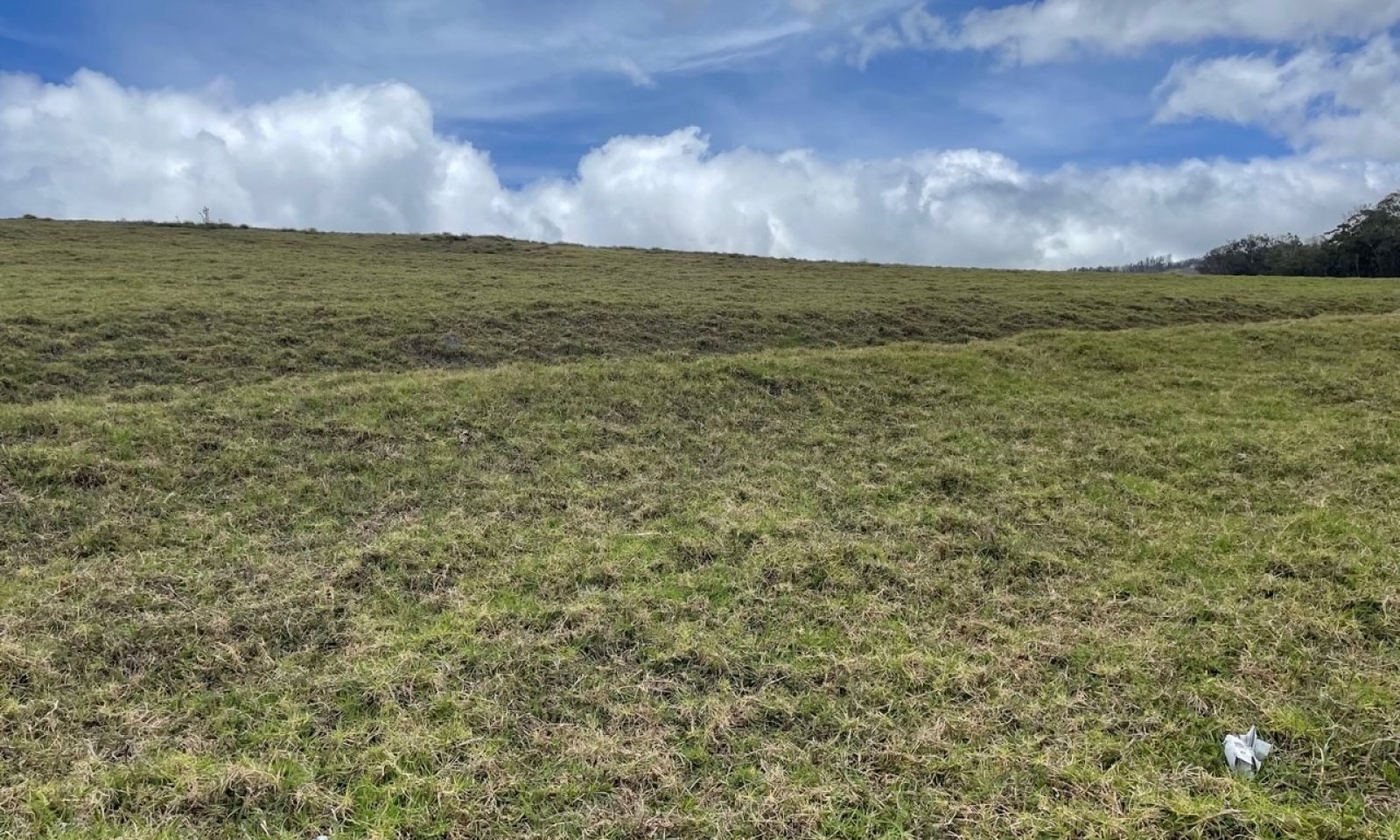
Isothermic Ustic Naturalized Grassland (Kikuyugrass)


Scenario model
Current ecosystem state
Select a state
Management practices/drivers
Select a transition or restoration pathway
-
Transition T1A
State 1 Reference will transition gradually to State 2 Weed-Invaded by invasion of competitive tree and shrub species, particularly black wattle, lantana, and christmasberry. The rate of conversion will depend on proximity of weed seed sources and the degree of overgrazing that creates bare soil and reduces the competitiveness of kikuyugrass.
More details -
Restoration pathway R1A
State 1 Reference may be restored to a facsimile of the original native forest. The site must be securely fenced to exclude all domestic and feral ungulates; protection from fire is also useful. Managed grazing outside the restoration site to control dense growth of grasses can reduce fire threat. Within the enclosure, introduced plants must be cut down, girdled, or killed with weed control measures. Replanting of native species then proceeds along with continuous weed monitoring and control. Supplemental water is usually needed until native plants are well established.
More details -
Transition T1B
State 1 Reference can transition to State 4 Fountaingrass-Invaded when competitiveness of kikuyugrass is reduced by overgrazing, allowing less-desirable fountaingrass (Cenchrus setaceus) to invade and establish. Eventually fountaingrass will carry a fire through the site, eliminating all other species with the possible exception of aalii (Dodonaea viscosa).
More details -
Restoration pathway R2A
Restoration of State 2 Weed-Invaded to State 1 Reference requires brush control followed by weed control. Re-establishment of desired forage grasses is likely to be needed.
More details -
Restoration pathway R2B
State 2 Weed-Invaded may be restored to a facsimile of native forest by constructing a fence designed to keep out ungulates (including deer, pigs, goats, and cattle), removal of all ungulates, establishment of fire protection, brush control, intensive and long term weed control, all followed by replanting of native species.
More details -
Transition T3A
This transition from State 3 Restored Native Forest to State 1 Naturalized Grassland is not recommended given the rarity of locations containing native plant species. It would occur quickly and easily by allowing ungulates and/or fire to access a site surrounded by State 1.
More details -
Transition T3B
State 3 Restored Native Forest gradually transitions to State 2 Weed-Invaded due to lack of native plant regeneration resulting from weed competition and ungulate browsing coupled with destruction of existing native plants by ungulates. The transition is rapid when fire carried by introduced grass species destroys other vegetation.
More details -
Transition T3C
State 3 Restored Native Forest transitions to State 4 Fountaingrass-Invaded if fountaingrass (Cenchrus setaceus) invades the site. Competition from fountaingrass would impede growth and reproduction of native species; eventually fountaingrass will carry a fire through the site, eliminating all other species with the possible exception of aalii (Dodonaea viscosa).
More details -
Restoration pathway R4A
We are unaware of this restoration having been performed. Fountaingrass might be heavily grazed and then killed with probably two applications of herbicide, with follow-up control of seedling emergence from the fountaingrass seed bank and introduction of a competitive desired grass species. Careful grazing, protection from fire, and continuous control of seedling fountaingrass from nearby areas may result in success.
More details - Restoration pathway T4A More details
-
Restoration pathway R4B
Grazing, mowing, or weed-whacking of fountaingrass followed by applications of herbicide to kill existing fountaingrass plants and follow-up herbicide to kill fountaingrass recruited from the site seedbank or nearby areas would be necessary. Dead fountaingrass plants and litter should be left in place to protect the soil from erosion. Planting of native plants could then proceed along with protection from ungulates and fire.
More details -
No transition or restoration pathway between the selected states has been described
Target ecosystem state
Select a state
State 1
Reference State


Description
This state consists of three community phases. Although formerly in forest vegetation, most of this ecological site is now covered by naturalized grassland. There is an almost continuous cover of grass with no or few trees, shrubs, and forbs. Few plants reproduce or survive in stands of highly-competitive kikuyugrass. Intense fires can be carried by kikuyugrass, both aboveground and in belowground plant parts. Community phase 1.1 consists primarily of kikuyugrass and leguminous forbs and vines. With intense or continuous grazing of livestock, a shift to phase 1.2 occurs, in which desirable forages are overgrazed and undesirable plants begin to increase. Phase 1.1 can shift to Phase 1.3 Abandoned Grassland, in which glycine vines cover the ground, shrubs, and trees. This shift is due to lack of grazing.
Submodel
State 2
Weed-Invaded State


Description
This state consists of one community phase. It is dominated by competitive, introduced, weedy species of trees, shrubs, and forbs that are not readily grazed or browsed by livestock.
Submodel
State 3
Restored Native Forest State


Description
This state consists of one community phase. Intact examples of the original native plant community no longer exist. This description is compiled from field observations of restored sites and protected patches, isolated plants on disturbed sites, historical accounts, and examination of remnant vegetation in shallow ravines. It is thought that the species found in these ravines are like those that previously existed on the uplands (McEldowney 1983). The largest remnant example currently has a high percent canopy cover of koaia (Acacia koaia). This may be due to the ability of koaia to reproduce and grow quickly in disturbed, sunny situations when protected from browsing animals. The original community may have had less koaia cover and more cover of other species.
There are accounts of koaia having been present in the middle of the 20th century on areas of this ecological site on the slopes of Mauna Kea (Billy Paris, rancher, personal communication). There also are a few naturally-occurring koaia on older soils on Puuanahulu near Puuwaawaa, in the southern extreme of this ecological site on Hawaii, and at some locations on Maui (Bob Hobdy, personal communication). Analysis of prehistoric land snail shells on Hawaii suggests that much of the original vegetation may have been like the xerophytic forest found near Puuwaawaa (Christensen 1983). Olopua (Nestegis sandwicensis) is thought to been a large component of this ecological site on the island of Maui (Pers. Comms. to Jennifer Higashino). This medium sized tree was common in dry forests throughout the islands of Hawaii especially at elevations between 1,000-4,200 ft.
The general appearance of this phase is an open to nearly closed canopy of low to medium height trees, a shrub understory, and a ground layer of vines, grasses, and sedges.
Submodel
State 4
Fountaingrass-Invaded State


Description
This state consists of two community phases that have continuous grass cover with no or very few trees, shrubs, or forbs. Fountaingrass (Cenchrus setaceus) may form nearly monospecific stands or may be interspersed with islands of buffelgrass (Cenchrus ciliaris) in drier areas. Although fountaingrass is competitive, the main reason few other plants fit into the concept of this state is the frequency and intensity of fires promoted by fountaingrass, which eliminates most other plants. With low fire frequency, koa haole (Leucaena leucocephala) and bush indigo (Indigofera suffruticosa) may be present. Persistent searching in fountaingrass stands may even reveal seedlings of native trees such as wiliwili (Erythrina sandwicensis), but they are unlikely to survive very long. The indigenous shrub aalii (Dodonaea viscosa) can survive in habitats with that burn frequently.
With continuous heavy grazing, particularly by cattle, fountaingrass will decrease. Koa haole and bush indigo (Indigofera suffruticosa) also will decrease under heavy grazing pressure. Increasers include jaraguagrass or thatchinggrass (Hyparrhenia rufa), barbwiregrass (Cymbopogon refractus), molassesgrass (Melinis minutiflora), Natal redtop or rose Natal grass (Melinis repens), bluestems (Bothriochloa spp.), and lesser amounts of buffelgrass and weedy forbs. With severe deterioration, shrubby species such as lantana (Lantana camara) and apple of Sodom (Solanum linnaeaum) increase. Shortgrasses such as Bermudagrass (Cynodon dactylon), kikuyugrass, low-vigor buffelgrass, and weedy annual forbs become more abundant, as well as lesser amounts of pricklypear cactus or Barbary fig (Opuntia ficus-indica). Pricklypear cactus abundance has been limited by an introduced biocontrol insect.
Submodel
Mechanism
State 1 Reference will transition gradually to State 2 Weed-Invaded by invasion of competitive tree and shrub species, particularly black wattle, lantana, and christmasberry. The rate of conversion will depend on proximity of weed seed sources and the degree of overgrazing that creates bare soil and reduces the competitiveness of kikuyugrass.
Mechanism
State 1 Reference may be restored to a facsimile of the original native forest. The site must be securely fenced to exclude all domestic and feral ungulates; protection from fire is also useful. Managed grazing outside the restoration site to control dense growth of grasses can reduce fire threat. Within the enclosure, introduced plants must be cut down, girdled, or killed with weed control measures. Replanting of native species then proceeds along with continuous weed monitoring and control. Supplemental water is usually needed until native plants are well established.
Mechanism
State 1 Reference can transition to State 4 Fountaingrass-Invaded when competitiveness of kikuyugrass is reduced by overgrazing, allowing less-desirable fountaingrass (Cenchrus setaceus) to invade and establish. Eventually fountaingrass will carry a fire through the site, eliminating all other species with the possible exception of aalii (Dodonaea viscosa).
Mechanism
Restoration of State 2 Weed-Invaded to State 1 Reference requires brush control followed by weed control. Re-establishment of desired forage grasses is likely to be needed.
Mechanism
State 2 Weed-Invaded may be restored to a facsimile of native forest by constructing a fence designed to keep out ungulates (including deer, pigs, goats, and cattle), removal of all ungulates, establishment of fire protection, brush control, intensive and long term weed control, all followed by replanting of native species.
Mechanism
This transition from State 3 Restored Native Forest to State 1 Naturalized Grassland is not recommended given the rarity of locations containing native plant species. It would occur quickly and easily by allowing ungulates and/or fire to access a site surrounded by State 1.
Mechanism
State 3 Restored Native Forest gradually transitions to State 2 Weed-Invaded due to lack of native plant regeneration resulting from weed competition and ungulate browsing coupled with destruction of existing native plants by ungulates. The transition is rapid when fire carried by introduced grass species destroys other vegetation.
Mechanism
State 3 Restored Native Forest transitions to State 4 Fountaingrass-Invaded if fountaingrass (Cenchrus setaceus) invades the site. Competition from fountaingrass would impede growth and reproduction of native species; eventually fountaingrass will carry a fire through the site, eliminating all other species with the possible exception of aalii (Dodonaea viscosa).
Mechanism
We are unaware of this restoration having been performed. Fountaingrass might be heavily grazed and then killed with probably two applications of herbicide, with follow-up control of seedling emergence from the fountaingrass seed bank and introduction of a competitive desired grass species. Careful grazing, protection from fire, and continuous control of seedling fountaingrass from nearby areas may result in success.
Mechanism
State 4 Fountaingrass-Invaded will transition gradually to State 2 Weed-Invaded by invasion of competitive tree and shrub species, particularly black wattle, lantana, and christmasberry. the rate of conversion will depend on proximity of weed sources, the degree of fire suppression, and the degree of overgrazing that creates bare soil and reduces the competitiveness of fountaingrass.
Mechanism
Grazing, mowing, or weed-whacking of fountaingrass followed by applications of herbicide to kill existing fountaingrass plants and follow-up herbicide to kill fountaingrass recruited from the site seedbank or nearby areas would be necessary. Dead fountaingrass plants and litter should be left in place to protect the soil from erosion. Planting of native plants could then proceed along with protection from ungulates and fire.
Model keys
Briefcase
Add ecological sites and Major Land Resource Areas to your briefcase by clicking on the briefcase ( ) icon wherever it occurs. Drag and drop items to reorder. Cookies are used to store briefcase items between browsing sessions. Because of this, the number of items that can be added to your briefcase is limited, and briefcase items added on one device and browser cannot be accessed from another device or browser. Users who do not wish to place cookies on their devices should not use the briefcase tool. Briefcase cookies serve no other purpose than described here and are deleted whenever browsing history is cleared.
Ecological sites
Major Land Resource Areas


The Ecosystem Dynamics Interpretive Tool is an information system framework developed by the USDA-ARS Jornada Experimental Range, USDA Natural Resources Conservation Service, and New Mexico State University.