


Natural Resources
Conservation Service
Ecological site QX197X01X506
Tuff or Rock Subsurface Forest
Last updated: 6/12/2025
Accessed: 03/13/2026
General information
Provisional. A provisional ecological site description has undergone quality control and quality assurance review. It contains a working state and transition model and enough information to identify the ecological site.
MLRA notes
Major Land Resource Area (MLRA): 197X–Volcanic Islands of American Samoa
This MLRA consists of the islands of Tutuila, Aunuu, Ofu, Olosega, and Tau. The islands have extremely steep, highly dissected mountains, small valleys, and a narrow coastal plain. More than half of the area has slopes of more than 70 percent. The highest elevations are 3,056 feet (931 meters) on Tau and 2,142 feet (653 meters) on Tutuila. The islands consist of Pleistocene-age, basic igneous rocks, mainly basalt with some andesite and trachyte.
The climate is moist, warm, and humid. Average annual rainfall ranges from 125 inches (3,175 millimeters) to more than 250 inches (6,350 millimeters). Rainfall varies over short distances due to topography. The driest months are June through September; the wettest months are December through March. Average annual temperature is 81 degrees F (27 degrees C). Relative humidity is 73 to 90 percent throughout the year. Prevailing winds are easterly trade winds. Cyclones occasionally strike the area.
Soils are Mollisols, Andisols, Entisols, Oxisols, and Histosols. Soil moisture regimes are udic or perudic; the soil temperature regime is isohyperthermic. Natural vegetation is mostly tropical hardwood forest.
Classification relationships
This ecological site occurs within Major Land Resource Area (MLRA) 197 – Volcanic Islands of American Samoa.
Ecological site concept
This ecological site occurs on the islands of Tutuila, Aunuu, Ofu, Olosega, and Tau in American Samoa. It occurs on gently sloping to very steep (6 to 70 percent) mountainsides and uplands at elevations ranging from 0 to 1500 feet (0 to 462 meters) elevation. Easiest access is on the eastern side of Tutuila and restricted elsewhere.
Soils are in the Oxisols order or Andic Hapludolls (Mollisols) subgroup. They formed in residuum, residuum with volcanic ash, or volcanic ash over a layer of highly weathered tuff. Soil temperature regimes are isohyperthermic; soil moisture regimes are udic. Average annual rainfall ranges from 150 to 230 inches (375 to 575 centimeters). Water runoff is slow to rapid. Effective rooting depths range from 20 to more than 60 inches (50 to more than 150 centimeters). Rock fragment content is low.
This forest type has high plant species diversity. The tree canopy grows up to 100 feet (30 meters) tall. Ground cover is moderate to dense; epiphytes and climbing plants are abundant.
Associated sites
| QX197X01X001 |
Coastal Marsh Coastal Marsh adjoins Tuff or Rock Subsurface Forest where uplands and mountain slopes descend to coastal depressions near sea level. Coastal Marsh ascends to 20 feet elevation and has very poorly drained soils, in contrast with Tuff or Rock Subsurface Forest, which occurs on slopes up to 1500 feet elevation and has well drained soils. |
|---|---|
| QX197X01X501 |
Mangrove Swamp Mangrove Swamp adjoins Tuff or Rock Subsurface Forest where uplands and mountain slopes descend to partially-protected areas of the coast that are open to seawater. It ascends to 20 feet elevation and has very poorly drained soils, in contrast with Tuff or Rock Subsurface Forest, which occurs on slopes up to 1500 feet in elevation and has well drained soils. |
| QX197X01X502 |
Sandy Littoral Forest Sandy Littoral Forest adjoins Tuff or Rock Subsurface Forest where uplands and mountain slopes descend to sandy coastlines. It ascends to 15 feet elevation, undergoes occasional, very brief to brief flooding by seawater, and has somewhat excessively to excessively drained soils, in contrast with Tuff or Rock Subsurface Forest, which occurs on mountain slopes up to 1500 feet in elevation, undergoes no flooding, and has well drained soils. |
| QX197X01X509 |
Very Steep Forest Very Steep Forest adjoins Tuff or Rock Subsurface Forest in mountainous areas where very steep slopes border on less steep slopes. Its soils are Andisols and Andic Mollisols on slopes of 70 to 130 percent; Tuff or Rock Subsurface Forest consists of Andisols, Andic Mollisols, and Oxisols on slopes of 6 to 70 percent. |
Table 1. Dominant plant species
| Tree |
(1) Syzygium |
|---|---|
| Shrub |
Not specified |
| Herbaceous |
(1) Angiopteris evecta |
Legacy ID
F197XY506AS

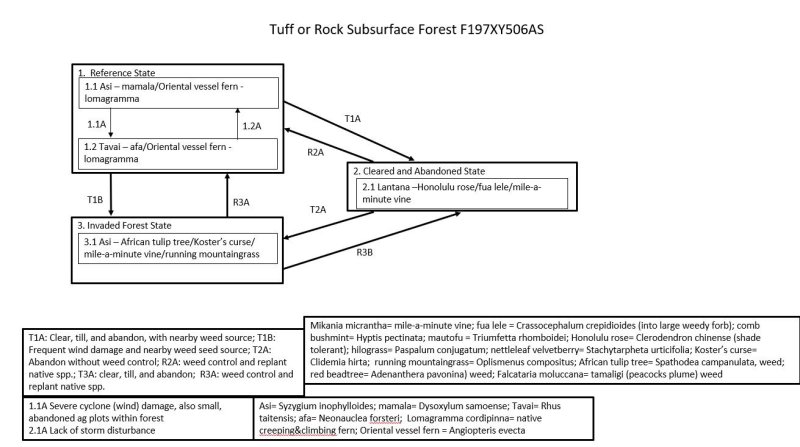


Click on box and path labels to scroll to the respective text.
Ecosystem states
| T1A | - | State 1 Reference transitions to State 2 Cleared and Abandoned by removal of native vegetation and allowing colonization by local species. |
|---|---|---|
| T1B | - | State 1 Reference transitions to State 3 Invaded Forest by localized landslides or wind damage to the forest when there is a nearby source of seeds of invasive species or, more gradually, by damage to the forest understory by ungulates, especially feral pigs, when there is a source of seeds of invasive species. |
| R2A | - | State 2 Cleared and Abandoned may be restored to State 1 Reference. The intensity of active restoration measures will be determined by the presence or lack of nearby native forest or, at least, some native trees as well as the density and species mix of grasses, vines, shrubs, and invasive trees present on the site, especially if many competitive introduced species are present. |
| T2A | - | State 2 Cleared and Abandoned transitions to State 3 Invaded Forest by growth of an overstory of trees with an understory of shade-tolerant shrubs, vines, ferns, forbs, and grasses. The species mix is variable but may be mostly introduced species or a combination of native and introduced species. |
| R3A | - | State 3 Invaded Forest can be restored to the Reference State. The difficulty, cost, and likelihood of success will depend on the species composition and amount and competitiveness of introduced species present on a given site. |
| R3B | - | State 3 Invaded Forest can be restored to State 2 Cleared and Abandoned. After this “restoration,” State 2 is likely to rapidly transition back to State 3 due to presence of an abundant tree seed bank in the soil. |
State 1 submodel, plant communities
| P1.1A | - | Landslides or storms that damage or kill trees causes a phase change from 1.1 to 1.2 typified by a partial, temporary change in dominant tree species and a temporary increase in ground level vegetation. |
|---|---|---|
| P1.2A | - | This community phase will revert to phase 1.1 with gradual regrowth of native species when given adequate time to recover after disturbance. |