

Loamy Exposed Backslope Woodland

Scenario model
Current ecosystem state
Select a state
Management practices/drivers
Select a transition or restoration pathway
- Transition T1B More details
- Transition T1A More details
- Transition T1C More details
- Transition T1D More details
- Restoration pathway R2B More details
- Transition T2A More details
- Restoration pathway R3A More details
- Transition T3A More details
- Transition T4A More details
- Transition T5A More details
-
No transition or restoration pathway between the selected states has been described
Target ecosystem state
Select a state
Description
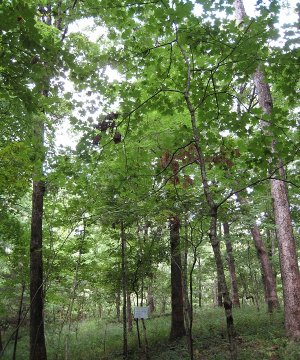
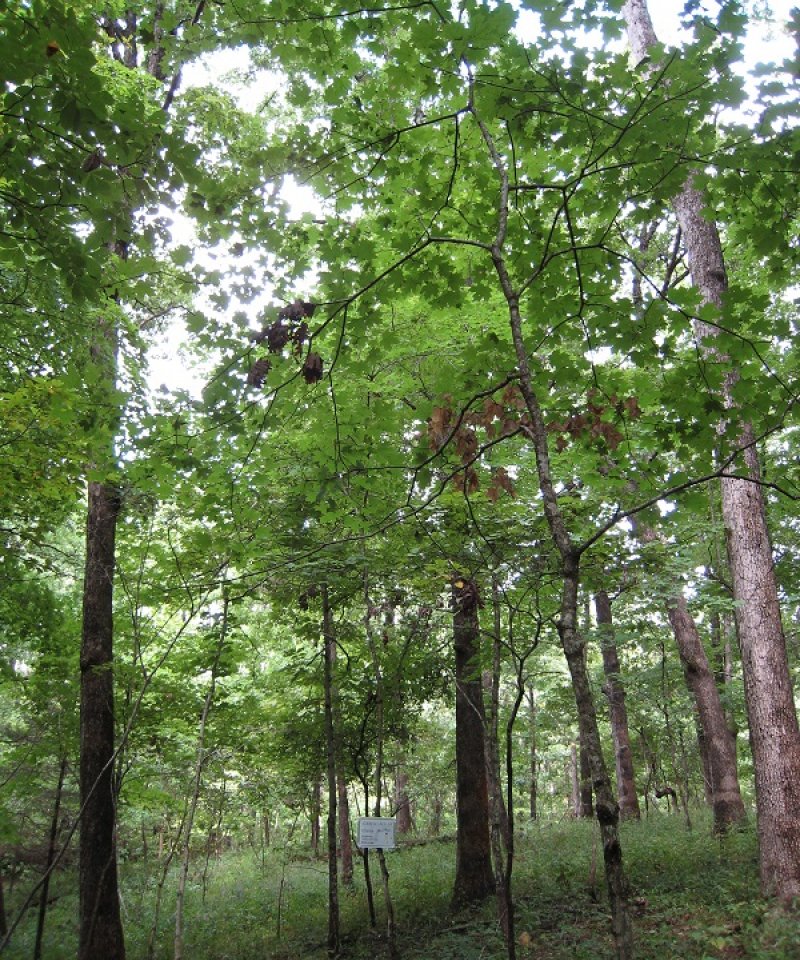
The historical reference state for this ecological site was old growth, oak woodland. The reference state was dominated by white oak, black oak, and hickory. Periodic disturbances from fire, wind or ice maintained the woodland structure and diverse ground flora species. Long disturbance-free periods allowed an increase in both the density of trees and the abundance of shade tolerant species. Two community phases are recognized in the reference state, with shifts between phases based on disturbance frequency.
Submodel
Description
These stands will slowly increase in more shade tolerant species and white oak will become less dominant. These woodlands tend to be rather dense, with a sparse understory and ground flora. Thinning can increase overall tree vigor and improve understory diversity. However, in the absence of fire, the diversity and cover of the ground flora is still diminished. Without periodic disturbance, stem density and fire intolerant species, like sassafras and hickory, increase in abundance.
Submodel
Description
Fire Managed Woodland state results from managing woodland communities with prescribed fire and canopy thinning. This state can resemble the reference state, but with younger maximum tree ages, more open canopies and lower ground flora diversity. Cessation of prescribed fire will allow transition to various managed woodland states.
Submodel
Description
Conversion of woodlands to planted, non-native cool season grassland species such as tall fescue is common for this region. Steep slopes, low organic matter contents and low soil infertility make grasslands harder to maintain in a healthy, productive state on this ecological site. Two community phases are recognized in the grassland state, with shifts between phases based on types of management.
Submodel
Description
States that were subjected to repeated, high-grading timber harvests and uncontrolled domestic grazing transitioned to a High-Graded, Grazed Woodland state. This state exhibits an over-abundance of hickory and other less desirable tree species, and weedy understory species such as coralberry, gooseberry, poison ivy and Virginia creeper. The existing vegetation offers little nutritional value for cattle, and excessive cattle stocking damages tree boles, degrades understory species composition and results in soil compaction and accelerated erosion and runoff.
Submodel
Mechanism
This transition is the result of fire suppression and uneven-age management.
Mechanism
This transition is the result of even-aged management and prescribed fire.
Mechanism
This transition is the result of clearing, grassland planting and grassland management.
Mechanism
This transition is the result of poorly planned harvest and uncontrolled grazing.
Mechanism
This restoration pathway is the result of forest stand improvement, prescribed fire and extended rotations.
Mechanism
This transition is the result of prescribed fire and forest stand improvement.
Mechanism
This restoration pathway is the result of forest stand improvement, prescribed fire and extended rotations.
Mechanism
This transition is the result of even-age management and fire exclusion.
Mechanism
This transition is the result of tree planting, long-term succession and livestock exclusion.
Model keys
Briefcase
Add ecological sites and Major Land Resource Areas to your briefcase by clicking on the briefcase ( ) icon wherever it occurs. Drag and drop items to reorder. Cookies are used to store briefcase items between browsing sessions. Because of this, the number of items that can be added to your briefcase is limited, and briefcase items added on one device and browser cannot be accessed from another device or browser. Users who do not wish to place cookies on their devices should not use the briefcase tool. Briefcase cookies serve no other purpose than described here and are deleted whenever browsing history is cleared.
Ecological sites
Major Land Resource Areas


The Ecosystem Dynamics Interpretive Tool is an information system framework developed by the USDA-ARS Jornada Experimental Range, USDA Natural Resources Conservation Service, and New Mexico State University.